Logo
IndianGlobalBlogsPublicationsPodcastsMarketAboutContact
Logo
IndianGlobalBlogsPublicationsPodcasts
7News
Feed Inflation Now Top Stress for India’s Dairy FarmersIndia’s Dairy Sector Rethinks Supply Trust & Nutrition StrategyU.S. Dietary Guidelines Overhaul Raises Dairy, MeatYear end review of Animal Husbandry and Dairy for the year 2025Fog & Frost Pose New Risks to Agriculture & Dairy in Punjab

Indian Dairy News

Feed Inflation Now Top Stress for India’s Dairy Farmers
Jan 09, 2026

Feed Inflation Now Top Stress for India’s Dairy Farmers

Dairy farmers across the country are facing intensifying economic stress as feed cost inflation emerges as the greatest pressure point for milk producers, with prices of all key inputs rising sharply,...Read More

India’s Dairy Sector Rethinks Supply Trust & Nutrition Strategy
Jan 09, 2026

India’s Dairy Sector Rethinks Supply Trust & Nutrition Strategy

India’s dairy industry — long anchored in high production volumes but thin value realisation — is undergoing strategic recalibration around supply reliability, consumer trust and long-term nutrition v...Read More

Year end review of Animal Husbandry and Dairy  for the year 2025
Jan 09, 2026

Year end review of Animal Husbandry and Dairy for the year 2025

Hon'ble Prime Minister inaugurates Regional Center of Excellence (CoE) for Indigenous Breeds established at Motihari with an investment of Rs 33.80 crore. Genotyping of 75000 animals from the first...Read More

DairyNews7x7
Advertisement

Latest Blogs

See More
From Forecast to Fact: 2025 Lessons, 2026 Dairy Outlook
Jan 01, 2026

From Forecast to Fact: 2025 Lessons, 2026 Dairy Outlook

As we step into 2026, it is worth pausing to reflect on how the Indian dairy sector navigated the challenges of 2025 and how closely reality tracked the forecasts I outlined in the first blog of last...Read More

India–NZ Dairy FTA: Safeguards or Silent Slippages?
Dec 26, 2025

India–NZ Dairy FTA: Safeguards or Silent Slippages?

The recently concluded India–New Zealand Free Trade Agreement (FTA) marks an important milestone in bilateral trade, while carefully ring-fencing India’s sensitive dairy sector. Under the agreement, c...Read More

Vision 2047: India’s Dairy Development Roadmap
Dec 21, 2025

Vision 2047: India’s Dairy Development Roadmap

As India moves steadily toward Vision 2047, the dairy sector stands at a strategic inflection point. From being a food security instrument in the decades following Independence, dairy has evolved into...Read More

Global Dairy Dynamics: Innovation, Sustainability & Inclusion
Dec 18, 2025

Global Dairy Dynamics: Innovation, Sustainability & Inclusion

The International Dairy Processing Conference (IDPC) 2026, organised by the Trade Promotion Council of India (TPCI) at Yashobhoomi Convention Centre, Dwarka, New Delhi on 7 January 2026, will serve as...Read More

Global Dairy News

U.S. Dietary Guidelines Overhaul Raises Dairy, Meat
Jan 09, 2026

U.S. Dietary Guidelines Overhaul Raises Dairy, Meat

The newly released 2025–2030 U.S. Dietary Guidelines, unveiled by Health Secretary Robert F. Kennedy Jr. and the Department of Agriculture, represent a major shift in federal nutrition policy, placing...Read More

Spoiled Dairy Becomes 3D Printing Plastic
Jan 07, 2026

Spoiled Dairy Becomes 3D Printing Plastic

Researchers patent a biomaterial from wasted milk proteins, creating biodegradable 3D printing filament and a potential new revenue stream for dairy. Excess milk that once flowed down farm drains duri...Read More

Milk production declines amid rising water costs
Jan 07, 2026

Milk production declines amid rising water costs

Dairy producers across Victoria are facing a tightening operating environment, with declining milk flows and escalating water and fodder costs, according to the Dairy Australia Situation and Outlook Y...Read More

DairyNews7x7
Advertisement
Dairy News 7x7

Your trusted source for all the latest dairy industry news, market insights, and trending topics.

FOLLOW US
CATEGORIES
  • Global News
  • Indian News
  • Blogs
  • Publications
  • Podcasts
SUBSCRIBE TO OUR NEWSLETTER

Stay informed with the latest updates and trending news in the dairy industry.

No spam, unsubscribe at any time

GET IN TOUCH
C-49, C Block, Sector 65,
Noida, UP 201307
+91 7827405029dairynews7x7@gmail.com

© 2026 Dairy News 7x7. All Rights Reserved.

Terms of ServicePrivacy Policy

Who moved Fonterra’s Cheese for the second time in India since 2002?

By Kuldeep Sharma•Published on March 15, 2022

Britannia industries Ltd proudly announced their joint venture with Global leader Fonterra from New Zealand on March 25th 2002. The main objectives of the JV were sourcing, manufacturing and distribution of milk and milk products in India. The new company had full access to Fonterra’s Research and development strengths . This access was mainly to help in further upgrading product quality and reducing product costs.

In April 2008 Fonterra chose to exit the JV.

Why did Fonterra choose to exit ?

Ms Vinita Bali ,Chairman BIL(in 2008) said Fonterra’s mainstay is ingredients (liquid milk, primarily) and has very little presence in branded business. “The company primarily is a cooperative of several New Zealand farmers and it didn’t see a big opportunity in India right now for its core competency (i.e. ingredients),” she added.

Mr Mark Wilson, Fonterra’s Managing Director – Asia Middle East, said: “For several years, Fonterra and Britannia have enjoyed a good business relationship. On an ongoing basis, we cast a critical eye over our investments to ensure that they reflect our key strategic priorities. While we are seeing a lot of growth in India, given the fragmented local milk supply that requires significant development, investing in India’s consumer dairy market is not a core priority for Fonterra at this time.”

In the fiscal year 2007-08, the joint venture company registered approximately a turnover of Rs 143 crore but returned a net loss of a little over Rs 5 crore after tax. Its net worth stood at close to just Rs 3 crore as of March 31, 2008.

Later on January 19 2013, Britania bought out Fonterra’s stake in dairy joint venture.

The Second innings : Fonterra Returns

On 8th August 2018 exactly after a decade of quitting Indian dairy space, Fonterra returned back. But this time, Fonterra announced a joint venture partnership with one of India’s largest consumer companies; Future Consumer Ltd , to produce a range of consumer and foodservice dairy products . Which will help meet the growing demand for high-quality dairy nutrition in India. The vision of Fonterra’s COO Lukas Paravicini on reentering into India are shared as below.

This partnership also didn’t last long . And last week in March 2022 , Fonterra decided to terminate its JV with Future Consumer Ltd. “Market disruptions during the pandemic and post pandemic times have been the main cause for this decision. Despite all the challenges, this JV launched its Dreamery range of milk shakes, Yogurts and Ghee. Indian consumers liked and appreciated all the products under Dreamery Brand.

Is Indian turf not fertile for Global dairy players ?

The exit of a global leader with presence in around 130 countries from India raises a lot of questions. This is not the first time that a global dairy has quitted business. French leader Danone also moved out of Retail value-added segment of yogurts and milk in 2018. Danone is still continuing to remain invested in India through well established brands like Protinex, Aptamil, Farex, Dexolac and Neocate.

“We will continue to have a presence in India through Anchor Food Professionals and our Ingredients business; and will explore opportunities to grow access for our New Zealand milk as they come up;” Fonterra’s Asia Pacific chief executive, Judith Swales said.

It is surprising to see that while most of Indian players improved their bottom lines during the pandemic period; the global giants were unable to take the advantage.

So what are the key reasons for these large global players to struggle on Indian soil ?

Judith quoted that though India was a large dairy consuming population but there was restrictive trade access for New Zealand dairy. The other key reasons as being quoted by other players from time to time are fragmented milk procurement and dependency of fresh milk products sales on General trade. In both the situations the infrastructure requirements at both the terminals of the dairy value chain is a big challenge along with poor cold chain logistics.

There have been mentions of challenges related to absence of level playing field for private sector players as against the dairy cooperatives. The government also recognises and supports these cooperatives more than the private sector. Protection of cows and dairy farmers has been the main objective of the Indian government which is to a certain extent reasonable also for a developing nation like India. Higher market share of the unorganised sector in the dairy industry is another big problem.

Does Value have a different connotation in India ?

At the end we must also examine the existing product mix of dairy products in India. During the pandemic, most of the companies in liquid milk supplies showed very good results. Indeed Liquid milk became the highest value added product during the pandemics. As far as global players are concerned, it is very difficult for them to build a network of milk procurement as well as market milk distribution at competitive rates.

The consumers on the other hand are happy talking about health and nutrition but are too price sensitive while spending money to purchase the value added dairy products. They have hardly contributed in uplifting the per capita consumption bar in value added dairy product categories.

The time is changing and a new era of health and nutrition conscious consumers is coming above the absolute threshold. In this decade the Indian dairy industry is all set for a paradigm shift. The organised sector share is bound to increase from around 40% to close to 60% by 2030. The product mix will also have liquid milk share squeezed to 55-60% from 67% currently and the value added products will almost be 30-35% by 2030.

Dairy is part of fragmented industries

There is no harm looking at the evolving Indian dairy-market to be more structured across the supply-chain in the future. There are IT professional groups like mooMark , milk lane etc who are creating a smart network of milk procurement . The online delivery companies like Milk Basket, Zepto are doing the same for the last mile delivery. Such startups may create plug-and-play opportunities for the Global brands to establish their local dairy-value-chain in no time in the future.

Michael Porter in his seminal work on competitive strategy talked about Fragmented industries in 1980. These are the industries with low entry barrier, no economies of scale, high transportation costs and no size advantage while dealing with the consumers. Dairy comes under this category in India. However now few brands like Amul, Mother Dairy, Hatsun, Parag, Heritage etc are bringing economies of scale with multi state presence.The government is also promoting the large scale investments in the sector .

The global brands have more insights about the Indian dairy market now than in the past. Nestle, Lactalis have shown the path to deep dive and establish the milk procurement first. Lactalis has also shown that the inorganic growth in India has a cost but it is plausible. Danone and Fonterra have highlighted the complexities of distribution channels for fresh value added products in India. Like Edison , the global players have also learnt a few of the ways which would undermine their big plans to establish a base in Indian dairy market.

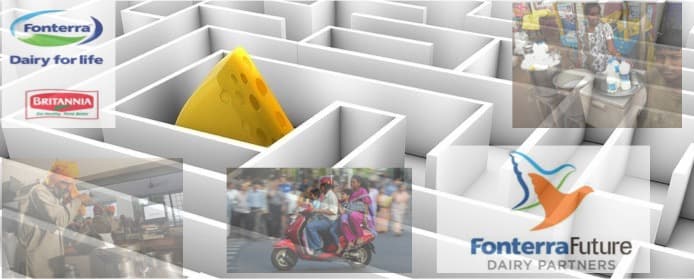
Global dairy players are not like Hem* and Hall *who felt betrayed and complained. These are like Scurry* and Sniff *who would enthusiastically head out into the maze to find new cheese. I am sure that these players will keep on knocking at the doors of Indian dairy market till they conquer.

(*Characters in “Who moved my cheese” written by Dr Spencer Johnson)

Source : A blog by Kuldeep Sharma , Chief editor , Dairynews7x

Swipe to continue reading

Previous Article

Next Article