Logo
IndianGlobalBlogsPublicationsPodcastsMarketAboutContact
Logo
IndianGlobalBlogsPublicationsPodcasts
7News
Dairy sector contributes 85% of methane emission in HPUS Dietary Guidelines Put Full-Fat Dairy in SpotlightUkraine Dairy in Deepest Crisis, Producers Urge Rescue PlanInvestment Surges Back Into Precision-Fermented DairyMilk Demand May Outpace Productivity Without Reforms

Indian Dairy News

Dairy sector contributes 85% of methane emission in HP
Mar 01, 2026

Dairy sector contributes 85% of methane emission in HP

The livestock and dairy production sector in Himachal Pradesh accounts for more than 85 per cent of the state’s annual methane emissions, a new scientific assessment has warned, cautioning that the si...Read More

Milk Demand May Outpace Productivity Without Reforms
Feb 28, 2026

Milk Demand May Outpace Productivity Without Reforms

Even though milk production in India is growing annually, the country's consumption is rising, potentially creating supply pressures if productivity improvements do not keep up, Brahmani Nara, Ex...Read More

Sikkim Cooperative conducted Clean Milk production program
Feb 28, 2026

Sikkim Cooperative conducted Clean Milk production program

The Sikkim Cooperative Milk Producers’ Union Limited successfully organized two consecutive one-day Awareness Programmes on Clean Milk Production (CMP) and Good Hygienic Practices (GHP) under the Nat...Read More

DairyNews7x7
Advertisement

Latest Blogs

See More
India’s First Cow Culture Museum in Mathura
Feb 16, 2026

India’s First Cow Culture Museum in Mathura

India’s first national “Cow Culture Museum” is set to be established in Mathura, Uttar Pradesh, on the campus of Pandit Deendayal Upadhyaya Veterinary Science University, announced the Uttar Pradesh B...Read More

Why India’s Dairy Needs a National Fodder Grid ?
Feb 15, 2026

Why India’s Dairy Needs a National Fodder Grid ?

Recently, I moderated the Farmer's session at 52nd DIC. While deliberating on pathways for Kerala to move towards milk self-reliance, K S Mani, Chairman of Milma, articulated a compelling thought: jus...Read More

Coliform in Milk -Look Beyond Brands to Cold Chain Gaps
Feb 12, 2026

Coliform in Milk -Look Beyond Brands to Cold Chain Gaps

Recent independent lab tests have triggered alarm over coliform bacteria and high total plate counts (TPC) in popular pouch milk brands — Amul Taaza, Amul Gold, Mother Dairy and Country Delight...Read More

DDGS & Sorghum Imports: Impact on Feed and Maize Prices
Feb 09, 2026

DDGS & Sorghum Imports: Impact on Feed and Maize Prices

In a significant development under the India-US interim trade framework, India has agreed to allow duty-free imports of dried distillers’ grains with solubles (DDGS) and red sorghum from the United St...Read More

Global Dairy News

US Dietary Guidelines Put Full-Fat Dairy in Spotlight
Mar 01, 2026

US Dietary Guidelines Put Full-Fat Dairy in Spotlight

The 2025–2030 Dietary Guidelines for Americans — jointly issued by the **US Departments of Health and Human Services and Agriculture — have elevated full-fat dairy products (like whole milk, fu...Read More

Ukraine Dairy in Deepest Crisis, Producers Urge Rescue Plan
Mar 01, 2026

Ukraine Dairy in Deepest Crisis, Producers Urge Rescue Plan

Ukraine’s dairy industry is currently experiencing the deepest crisis in recent years, with industry representatives warning that without swift government action up to 20 % of industrial milk producti...Read More

Investment Surges Back Into Precision-Fermented Dairy
Mar 01, 2026

Investment Surges Back Into Precision-Fermented Dairy

Funding into precision-fermented dairy — where microbes are used to produce dairy proteins without cows — is seeing a renewed uptick as investor interest returns amid growing demand for sustainable pr...Read More

DairyNews7x7
Advertisement
Dairy News 7x7

Your trusted source for all the latest dairy industry news, market insights, and trending topics.

FOLLOW US
CATEGORIES
  • Global News
  • Indian News
  • Blogs
  • Publications
  • Podcasts
SUBSCRIBE TO OUR NEWSLETTER

Stay informed with the latest updates and trending news in the dairy industry.

No spam, unsubscribe at any time

GET IN TOUCH
C-49, C Block, Sector 65,
Noida, UP 201307
+91 7827405029dairynews7x7@gmail.com

© 2026 Dairy News 7x7. All Rights Reserved.

Terms of ServicePrivacy Policy
Prefer Us
Prefer Us

Dairy sector contributes 85% of methane emission in HP

By DairyNews7x7•Published on March 01, 2026

Dairy sector contributes 85% of methane emission in HP
Prefer on

The livestock and dairy production sector in Himachal Pradesh accounts for more than 85 per cent of the state’s annual methane emissions, a new scientific assessment has warned, cautioning that the situation could worsen significantly if timely remedial measures are not adopted.

The findings are part of a report titled “Scientific Assessment of Tackling Non-CO2 Emissions: Pathways for Himachal Pradesh”. The report was released on February 24. The study highlights that methane emissions from livestock and domestic cattle form the overwhelming share of the state’s non-carbon dioxide greenhouse gas burden, while the remaining 15 per cent is attributed to landfill sites, waste management and related sectors.

Report prepared by IGSD, TERI and Environment dept, HP

The report has been jointly prepared by the Institute for Governance and Sustainable Development (IGSD), The Energy and Resources Institute (TERI) and the Himachal Pradesh Department of Environment, Science and Technology.

“Livestock contributes nearly 85 per cent of annual methane emissions in the baseline year and emissions are projected to continue rising under a Business-As-Usual (BAU) scenario. For the purpose of the assessment, 2019 was taken as the baseline year,” the study stated.

“Almost 12 per cent of methane emission can be curbed through the balanced feeding of livestock and around 27 per cent under the combing pathway including fodder management and breed preservation.”

Dr Nimish Singh, director (Science) at IGSD, told The Indian Express that the state’s unique agricultural profile explains the disproportionate contribution of livestock to methane emissions. “There are certain reasons why 85 per cent of emissions were attributed to livestock and dairy farming in Himachal. In states like Punjab and Haryana, paddy cultivation is the largest source of methane emissions, followed by dairy, landfill etc. But in Himachal, paddy production is marginal and largely confined to plain areas bordering Punjab and Haryana,” he said.

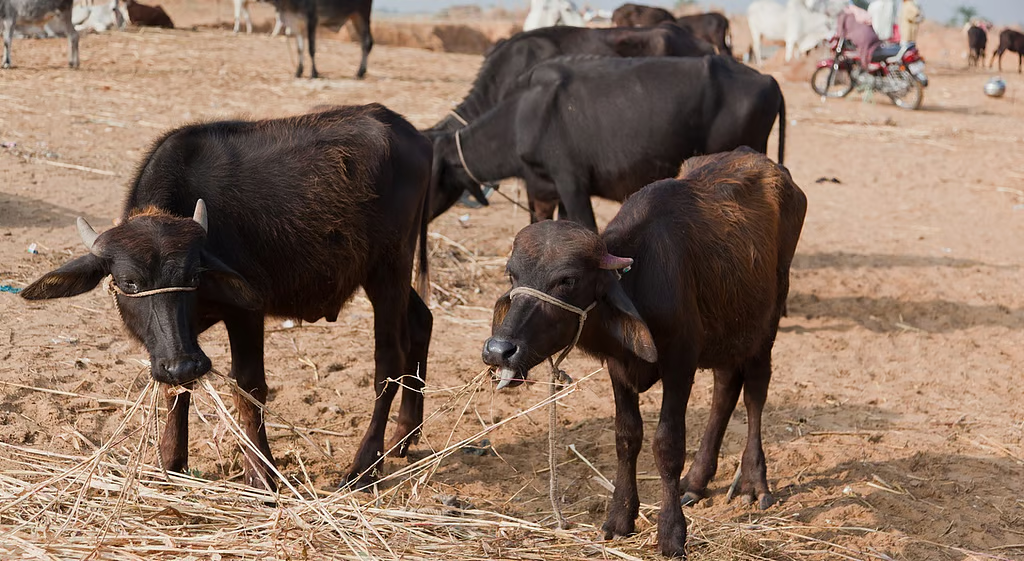
The expert clarified that the livestock category considered in the study includes only cows and buffaloes. “In terms of methane accounting, goats, sheep and pigs are not included in this category,” he added. He accepted the fact that rearing goats, sheeps is more overwhelming than cows and buffalos, especially in the higher reaches and snow-bound areas.

Pranjali Chowdhary, policy strategist with IGSD, said that 2019 was selected in line with national climate accounting practices. “The Government of India is also using 2019 as the baseline year for its national climate and cleanliness policies. The report not only assesses emissions but also provides a set of practical solutions to reduce methane, which have been submitted to the state government,” she said.

Policy recommendations include expanding balanced fodder programmes, improving feed quality through silage and fodder banks, scaling up household and community-level biogas plants using manure, and aligning indigenous cattle conservation with productivity enhancement. The report also suggests leveraging the state’s milk Minimum Support Price framework to improve farmer incomes while reducing emission intensity.

Data from the Himachal Pradesh Animal Husbandry Department indicates that nearly 6.5 lakh cows and buffaloes become pregnant annually in the state. They remain in lactation for six to seven months during pregnancy, followed by a dry period of about three months — a biological cycle that significantly influences methane output through enteric fermentation.

The report proposes alternative scenarios centred on balanced feeding practices and promotion of indigenous cattle breeds. These pathways are projected to deliver methane emission reductions of around 12 per cent through balanced feeding alone and up to 27 per cent under a combined strategy that includes improved fodder management and breed preservation.

The study further said that however, even under these mitigation pathways, livestock is expected to remain the dominant source of methane emissions in the state, underscoring the need for focused climate action in this sector.

Methane, a colourless and highly flammable greenhouse gas, has over 80 times the warming potential of carbon dioxide over a 20-year period and is considered a critical target for rapid climate action. At the national level, livestock accounts for nearly 48 per cent of total agricultural methane emissions, with 100 out of 721 districts contributing around 40 per cent of the total burden.

Source : Dairynews7x7 March 1st 2026 Indian Express

#methane #climatechange #GHGemission #teri #dairy #livestock

Stay Updated

Get the latest dairy industry news directly in your feed.

Prefer Us on Google Search

Swipe to continue reading

Previous Article

Next Article