As we step into a new financial year, the dairy industry stands at a crossroads shaped by multiple forces—climate fluctuations, milk availability, feed and fodder dynamics, and shifting market conditions. The road ahead will be defined by how these variables interact, influencing production, pricing, and sustainability. Scenario planning isn’t just an exercise; it’s a necessity to navigate uncertainties and make informed decisions. By assessing the current landscape, we can anticipate challenges, seize opportunities, and build resilience for the future. What does the year ahead hold for dairy? Let’s explore the possibilities.
ENSO and India’s Climate: A Year of Uncertainty
Conflicting climate signals make 2025 a year of deep uncertainty for India. On one hand, the expected La Niña—typically associated with good monsoons—has not fully materialized, as unusual sea surface temperature (SST) anomalies persist in the Pacific. Forecasts remain divided: some models predict La Niña, others anticipate neutral conditions, and a few even suggest a return of El Niño. The Indian Ocean Dipole (IOD) adds another layer of unpredictability, leaving monsoon expectations in limbo.
On the other hand, India faces an intensifying climate crisis. Rising global temperatures, record-breaking heatwaves, and shifting jet streams indicate that even a La Niña may no longer provide the expected cooling relief. February 2024 was the hottest since 1901, heatwave days are at a 14-year high, and extreme temperatures are becoming the new normal.
As the monsoon forecast hangs in uncertainty and heatwaves intensify, India must brace for both possibilities—coping with erratic rainfall and enduring extreme heat. With climate models struggling to predict these shifts accurately, all eyes remain on evolving weather patterns. Fingers crossed!
Record production of feed and fodder
The 2024/25 aggregate paddy production is forecast at record 214.2 million tonnes. Harvesting of the 2024 secondary
Rabi maize crop is underway and will conclude by May, while the main
Kharif maize crop was harvested in November 2024. The 2024 aggregate maize production is forecast at a record level of 38.1 million tonnes, owing to large sowings due to strong demand by the local feed industry. The 2024 wheat production, harvested in June 2024, is officially estimated at record 113.3 million tonnes. Overall, the 2024 aggregate cereal output is forecast at record 385.2 million tonnes (rice in paddy terms).
Situation of water reservoirs
As of February 20, 2025, the water reservoir levels present a positive outlook for the dairy industry. The live storage in 155 major reservoirs stands at 98.974 BCM, which is 55% of total capacity. Encouragingly, this is 120% of last year’s level and 116% of the 10-year average. The overall storage position is not only better than the same period last year but also exceeds the normal storage levels for this time of the year. With ample water availability, dairy farmers can expect improved irrigation for fodder cultivation, ensuring better feed security and supporting stable milk production in the months ahead.
Area under sowing has improved
The latest progress report from the Ministry of Agriculture & Farmers Welfare reveals a strong start to summer crop sowing in 2025, with the total area covered reaching 37.539 lakh hectares—6.538 lakh hectares more than last year. This notable increase reflects favorable climatic conditions and proactive efforts by farmers and the government to maximize agricultural output. Rice remains the dominant summer crop, expanding by 2.804 lakh hectares to 27.134 lakh hectares, supported by improved irrigation and government initiatives.
Pulses have seen remarkable growth, with the sown area more than doubling to 5.016 lakh hectares, driven by high market demand and favorable price support. The Shree Anna cum Coarse Cereals category has also expanded, particularly in maize and jowar, reinforcing the shift towards climate-resilient crops. While oilseeds witnessed a slight decline, the overall summer crop scenario remains positive, signaling a promising season for Indian agriculture.
Exports of Buffalo meat
The USDA predicts a rise in India’s beef (mostly carabeef) production and exports in 2025, driven by increased policy support and growing demand. Production is set to reach 4.64 MMT (up from 4.57 MMT in 2024), while exports are expected to rise to 1.64 MMT from 1.56 MMT last year. By December 2024, India had already exported 0.92 MMT of beef, valued at $2.93 billion—nearly nine times the total dairy exports during the same period.
India remains the global leader in bovine population, with 307.5 million cattle and buffaloes. Slaughter-ready stock has slightly increased to 41.41 million head in 2025, aligning with the reported 16% decline in buffalo numbers from the Basic Animal Husbandry Statistics 2024, though this reduction hasn’t impacted their share in total milk production. Domestic beef consumption is also set to rise to 3.06 MMT (from 3.0 MMT in 2024), as inflation drives demand for this lower-cost protein source. Government initiatives, including grants from MoFPI for abattoirs and subsidies under the National Livestock Mission, continue to support the sector’s expansion.
Variables for Scenario Planning
Looking at these variables, except for climatic uncertainties, there seems to be no major challenge to the smooth operation and sustainability of dairy plants during the summer of 2025. Milk availability remains stable, including buffalo milk, and stock positions with large cooperatives are nearing optimum levels for this time of the year. The private sector has also built SMP stocks meticulously. Moreover, value-added products have shown early traction this summer, which is a positive sign.
Given this backdrop, what other variables should we consider apart from climate conditions? Three key factors come to mind: market demand, feed availability, and government interventions. Among these, feed availability is unlikely to be a major concern, and based on past trends, significant government intervention is also not expected. This leaves market demand—which may either remain stable or turn volatile, impacting both milk and commodity markets.
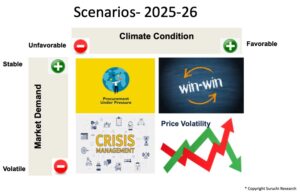
While summer is not typically a peak season for butterfat consumption, continued export demand could exert pressure on local markets. SMP demand may cause intermittent market fluctuations but is unlikely to drive sustained disruptions. If we map these dynamics using climate conditions (favorable/unfavorable) on one axis and market demand (stable/volatile) on the other, we arrive at four possible scenarios:
Climate Impact vs. Market Demand
- X-axis: Climate Conditions (Favorable / Unfavorable)
- Y-axis: Market Demand (Stable / Volatile)
Scenarios:
- Favorable Climate & Stable Demand → Win-Win
- Favorable Climate & Volatile Demand → Price Volatility
- Unfavorable Climate & Stable Demand → Procurement under Pressure
- Unfavorable Climate & Volatile Demand → Crisis Management
Here’s a brief note on these scenarios:
- Favorable Climate & Stable Demand → Win-Win
With ideal weather conditions supporting milk production and steady demand, the dairy industry enjoys stable prices, smooth supply chains, and healthy farmer incomes. This scenario fosters growth, investment, and long-term sustainability.
- Favorable Climate & Volatile Demand → Price Volatility
While good climatic conditions ensure ample milk supply, unpredictable demand fluctuations can lead to price instability. Processors and farmers must navigate surplus management and market interventions to maintain profitability.
- Unfavorable Climate & Stable Demand → Procurement under Pressure
Climate challenges, such as droughts or excessive heat, reduce milk yields, straining procurement. With demand remaining steady, supply shortages may drive up prices, requiring efficient sourcing strategies and policy support.
- Unfavorable Climate & Volatile Demand → Crisis Management
A worst-case scenario where adverse weather hampers production while erratic demand disrupts pricing and supply chains. This requires robust crisis management, including strategic reserves, alternative sourcing, and government interventions to stabilize the market.
The future may be uncertain, but one thing is clear—the unwavering spirit of the Indian dairy industry, the resilience and business acumen of our dairy entrepreneurs, and the strong support from the government will ensure we navigate any challenge that comes our way. Whether we face stability or volatility, abundance or scarcity, our ability to adapt, innovate, and work together will define our success.
With determination and optimism, we step into this new financial year, ready to turn every challenge into an opportunity. Wishing everyone in the industry a year of growth, prosperity, and excellence.
Happy and prosperous Financial Year 2025-26! 🚀🥛
Source : Blog by Kuldeep Sharma Chief Editor Dairynews7x7.com