Latest Blogs
See More

Indian Dairy News

DairyNews7x7
Global Dairy News


DairyNews7x7
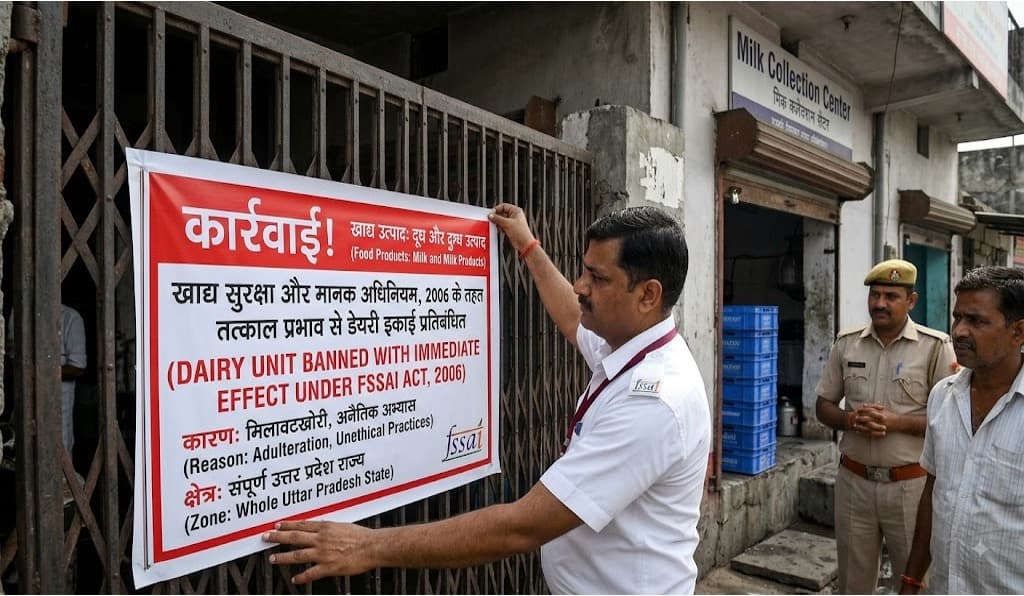
For the last few months, India has witnessed an unprecedented series of enforcement actions against food adulteration. Maharashtra has led the headlines with large-scale inspections, raids and action against food business operators involved in milk and dairy adulteration.
Every few months, a state finds its hero. A Food Commissioner leads a raid, adulterated milk is poured out on camera, a paneer consignment is seized, and for a few days, the regulator becomes the story instead of the food. Maharashtra is living that moment now. Andhra Pradesh's laboratories have flagged worrying microbial numbers. And across Dairynews7x7's own coverage, month after month, the pattern repeats itself in one state or another — a burst of enforcement energy, a flurry of headlines, and then, often, a transfer order that quietly resets the clock.
This is not a criticism of the officers who lead these drives. Their intent is usually genuine, and the visibility they bring to food safety is welcome in a country where adulteration has for too long been treated as background noise. The real question this pattern raises is a more structural one: why does the intensity of food safety enforcement in India depend so heavily on which individual happens to be sitting in a particular chair, in a particular state, at a particular time?
FSSAI's recent tightening around labelling claims — energy drinks, "fresh," "natural" — is a sign of a regulator maturing, willing to revisit definitions that have gone unquestioned for years. That is exactly the kind of institutional strengthening the sector needs. But strong intent at the top has to be matched by a system at the ground level that behaves consistently, regardless of geography, political cycle, or personal initiative. Enforcement that surges and fades with individual postings cannot, by itself, build the kind of durable consumer trust that India's dairy and food sector needs to grow.
The heart of food safety enforcement is the sample — the physical evidence around which every prosecution, penalty, or clean chit is built. And it is at this very first step that the system's design leaves room for inconsistency. When a sample is drawn, the Food Business Operator is offered a choice: request that the sample additionally be sent to an independent NABL-accredited third-party laboratory, or let the matter rest with the outcome of the state-level lab.
Most operators do not exercise that choice. But even when they do not, this does not mean their sample simply bypasses scrutiny — it still goes first to the state or district-level food laboratory, the very same laboratory that works in close, everyday proximity with the local food safety officers who draw these samples. Over years of shared postings, shared districts, and shared routine, this proximity naturally evolves into familiarity between officers and chemists — a closeness that, at the first and most decisive level of testing, leaves quiet room for discretion to enter a process that should ideally leave none. This is simply how incentives work, everywhere, in every system. It is not a comment on any individual's integrity — it is a comment on design.
A regulatory framework that leaves this much discretion at a single point, held between one inspector and one operator, will always produce uneven outcomes. Some regions will see rigorous, fearless testing. Others won't. And the difference will rarely be about how much adulteration actually exists on the ground — it will be about how the sampling process happened to be handled.
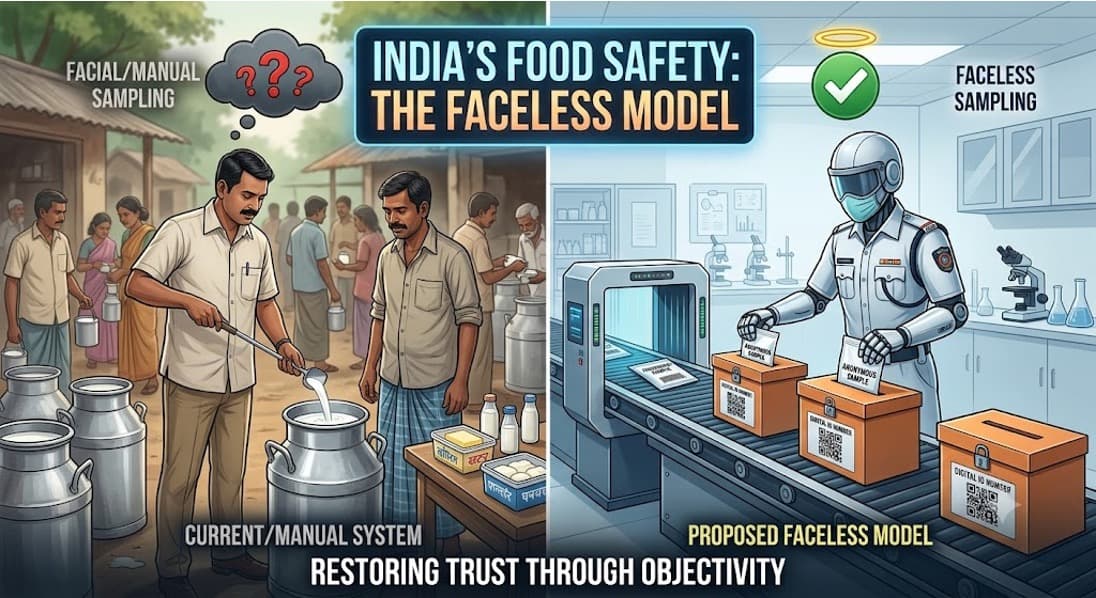
India does not need to look abroad for a solution. It has already built one, in a completely different domain. When the Income Tax Department moved to faceless assessment, the underlying insight was simple: remove the direct, identifiable link between the assessee and the assessing officer, and you remove the informal pressure points that had built up around that relationship over decades. The tax officer no longer knows whose file they are looking at; the taxpayer no longer knows who is reviewing their case. The system became less about individuals and more about process.
Food safety sampling in India is ready for the same shift. And the beauty of this idea is that it does not require new legislation, new manpower, or new laboratories. It only requires India's existing infrastructure to be sequenced differently.
First, make third-party testing the rule, not the exception. Every fourth sample collected — across every district, every category, every inspector — should be sent mandatorily to an independent NABL-accredited laboratory, with no option for the FBO or the inspector to redirect it. If the sample fails, the cost is borne by the FBO. If it passes, FSSAI absorbs the cost. This single change converts third-party testing from a rarely-exercised option into a statistically meaningful, unavoidable check built into the system itself.
Second, anonymise the sample at the point of collection. Every sample drawn by a Food Safety Officer should carry a pre-generated barcode, generated centrally, that the officer collecting it has no visibility into. Their role becomes purely custodial: collect, seal, and deposit the sample at a centralised district-level collection centre. The identity of the sample — which FBO it came from, which product, which location — stays with the code, not with the person carrying it.
This is, in fact, a model India already trusts with something far more personal than a milk sample — its own blood. When a diagnostic company sends a phlebotomist for a home blood collection, the executive arrives carrying pre-printed barcode stickers generated by the lab's central system. Each sticker is simply pasted onto the vial at the time of collection. The person drawing the blood does not know, and does not need to know, which specific tests have been ordered or what the results will eventually show — their job ends at collection. The vial then travels through the system on the strength of its code alone, read and processed by professionals who never meet the patient and never meet the collector. Nobody finds this arrangement unusual; it is simply accepted as the sensible way to keep a process accurate and impersonal. Food sampling asks for nothing more radical than this same, quiet discipline.Third, let the system, not the district, decide where a sample goes. The centralised collection centre, not the local food safety office, should be responsible for dispatching samples to laboratories based on the coded system — and crucially, those laboratories need not be the ones administratively linked to that district at all. A second layer of re-coding before final dispatch would add one more safeguard, ensuring that even the testing professional at the laboratory has no way of knowing whose sample they are examining, or which officer collected it.
The outcome of this simple, three-step redesign is powerful in its symmetry: the inspector who collects the sample does not know where it is going. The laboratory that tests it does not know where it came from. And the result, when it emerges, is tied only to a code — not to a relationship, a district, or a designation. Enforcement stops being a function of who is posted where, and becomes a function of the system itself.
India's food safety journey does not need more raids to prove that the regulator is watching. It needs a design that makes watching unnecessary to prove — because the process itself guarantees it, every day, in every district, regardless of who holds the post. A faceless sampling architecture would not diminish the good work being done in states like Maharashtra today; it would simply ensure that the same rigour travels automatically to Andhra Pradesh, to Bihar, to every corner of the country, and stays there long after any one transfer order is signed.
FSSAI has already shown, through its recent labelling actions, that it is willing to modernise the way it thinks about compliance. Extending that same spirit of reform to its most foundational activity — the humble act of drawing a sample — could be the single most consequential step the regulator takes this decade. Not because it punishes anyone, but because it finally makes fairness a feature of the system, rather than a matter of chance.
Perhaps the time has come for India to move towards Food Safety 2.0—where technology complements regulation, transparency strengthens enforcement, and scientific evidence becomes the sole basis for regulatory action.
FSSAI could consider piloting a Faceless Food Safety Enforcement System in a few selected states. A carefully designed pilot would help test the operational feasibility, calibrate the digital workflow, evaluate turnaround times, and compare the quality and consistency of enforcement outcomes with the existing system. Such an evidence-based approach would provide valuable insights before any nationwide rollout.
The objective is not to replace the vital role of Food Safety Officers, but to empower them with a technology-enabled system that promotes uniformity, objectivity and greater public confidence. At the same time, it would reassure compliant Food Business Operators that regulatory decisions are driven entirely by scientific testing conducted through a transparent and impartial process.
As India aspires to become a global food manufacturing and export powerhouse, its regulatory architecture must evolve alongside its ambitions. Food Safety 2.0 should represent a paradigm shift—from person-centric enforcement to system-centric governance; from discretion to digital transparency; and from suspicion to trust built on science. That, perhaps, is the next milestone in India's food safety journey—one that protects consumers, strengthens honest businesses and enhances the credibility of the regulatory ecosystem for decades to come."The future of food safety will not be defined by more raids, but by better systems. India's consumers deserve it, India's honest Food Business Operators expect it, and India's food regulator has the opportunity to lead this transformation."
— Editorial by Kuldeep Sharma Chief Editor Dairynews7x7.com July 12th 2026