Latest Blogs
See More


Indian Dairy News


DairyNews7x7
Global Dairy News
DairyNews7x7
In the world-wide quest for dairy modernisation, the focus on crossbreeding and productivity increase of dairy cattle has — besides enhanced milk production — also resulted in high use of agro-chemicals. The use of antibiotics for common cattle diseases, such as udder infection and diarrhoea, is widespread. This contributes to the global threat of anti-microbial resistance (AMR).
This international network on knowledge development for livestock health is re-valuing time-tested methods, such as use of medicinal plants and strategic use of local breeds, to be applied in a modern context. NLF combines knowledge from various backgrounds including farmer knowledge, western veterinary science and ayurveda.
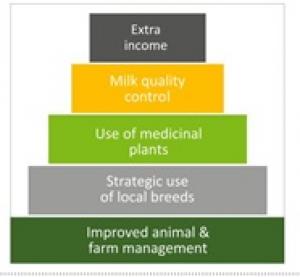
The foundation improves cattle health on basis of the NLF 5-layered approach (van’t Hooft et al., 2017) comprising:
This opens up opportunities that more conventional livestock development programmes fail to unlock, providing opportunity for increased farm income, better child nutrition, food safety & security, as well as improved environment.
Over the past decade, NLF India (a collaboration between GLOHMSIWA Research Labs Pvt Ltd and Trans Disciplinary University) has trained a total 30.000 farmers and 2,000 veterinarians on efficient use of herbs for cattle health, also known as EVP. (M.N.B. Nair, 2019)
Since 2017, the method has been adopted by the National Dairy Development Board. Through an online reporting system, the empirical data of more than 556,000 cases of 30 bovine diseases cured with herbal medicine were recorded. An overall average cure rate of 82 per cent, as well as an 87 per cent reduction of antibiotic use were registered within two years after the training.
NLF in Ethiopia (headed by Ethiopian Society of Animal Production ESAP), implemented an action research based on the NLF approach in two zero-grazing smallholder dairy communities.
Experts from NLF India headed a training on the use of medicinal plants (mainly kitchen herbs), while organisations collaborating with NLF Netherlands guided training on laboratory skills and calf management.
In two years, the approach has shown significant improvement in milk quality (eight per cent antibiotic residue reduction) and quantity (over 50 per cent increase), farm income (33 per cent increase), while calf mortality was reduced by 60 per cent.
Average costs for cattle health were reduced by 20 per cent. The outcomes of this pilot will have a bearing in supporting the Ethiopian Ministry of Agriculture in improving milk quality and to scale up the strategy into various dairy programmes.
The initial focus of NLF in Uganda (headed by the Lake Mburo Farmers Cooperative Society) was on natural control of ticks and tick-borne diseases among smallholder ranging cattle.
A herbal recipe based on local plants was developed by experts from NLF India and tried out in 2017-2018. In recent years the society has also focused on diversifying farm activities including value addition and local marketing of dairy products.
Since 2014, a one-to-one relationship between farmers and veterinarians on the use of antibiotics was enforced by the government, with mandatory (national) registration of antibiotic use. As a result, the use of antibiotics in the total livestock production systems was reduced to around 70 per cent compared to 2009, though the decrease is now stagnating.
In the Dutch dairy sector, increased use by farmers of ready-made natural products was one of the major changes for mastitis prevention and cure. Moreover, farmers started to re-introduce herbs in the cattle feed and ray-grass monoculture grasslands.
This exposed the lack of knowledge among farmers and veterinarians, both about herbal grassland management and the safety of herbal products. Since 2018, NLF in the Netherlands has trained farmers and veterinarians on the safe use of herbal products and herbal grassland management. The Dutch government has invested in the spread of knowledge on natural remedies via so-called Barn-books (Groot et al., 2021).
The strategic collaboration headed by NLF has brought about a road map on improving cattle health and milk quality. Now that proof of concept about the NLF approach including EVP is available it is time for further upscaling into mainstream dairy policies, extension and education.
For this, NLF is reaching out to non-profits, governments, research institutes and funding agencies, while organising webinars, field level pilots and international exchanges.
Katrien van’t Hooft is Executive director Natural Livestock Farming Foundation (NLF); director Dutch Farm Experience, Netherlands
MNBNair is Head NLF in India, Head Department Ethno Veterinary Science and Practice of trans Disciplinary University
Source : Down To Earth Nov 29th 2023 Views expressed are the author’s own and don’t necessarily reflect those of Down To Earth