Latest Blogs
See More
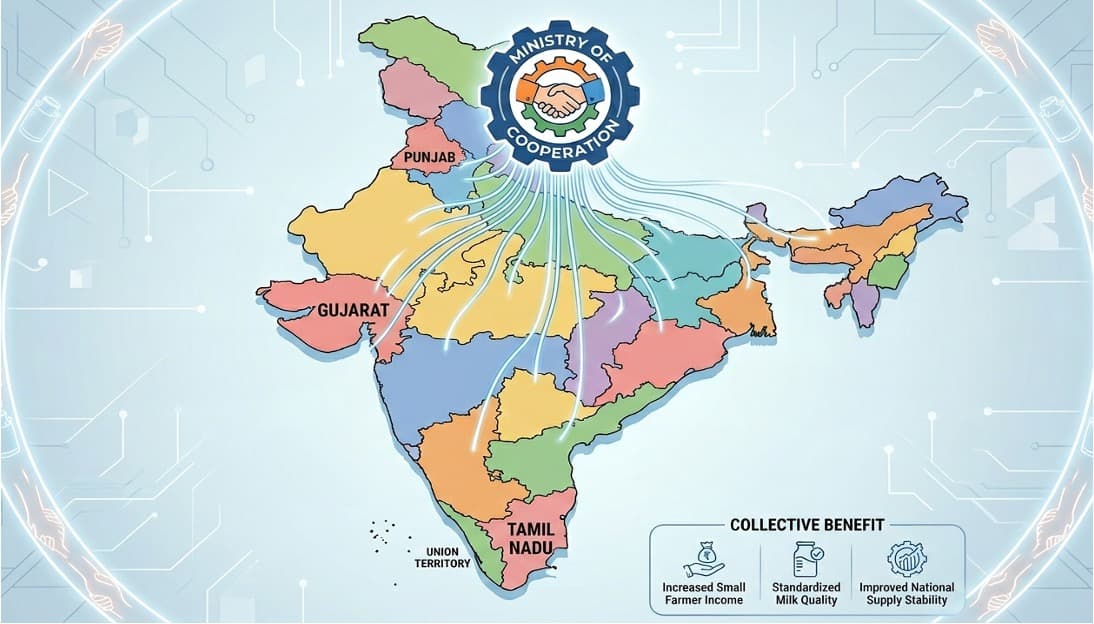
A Quiet Centralisation: What the New Cooperative Push Means for India’s Private Dairy Sector
As reported by agencies citing a written reply by the Union Minister of Cooperation, Amit Shah, in the Rajya Sabha, the government has outlined a plan to bring nearly 45,000 milk collection and pooling centres under the cooperative framework—signalling a structural shift in how milk procurement is likely to be organised in India going forward.
As per the reply, most of the District Cooperative Milk Unions and State Milk Federations primarily procure milk within their respective States. However, some dairy cooperatives have expanded their procurement operations beyond their States. Though National Dairy Development Board collects data on total milk procurement by the dairy cooperatives (Milk Federation and Unions), the data on inter-state expansion of dairy cooperatives is not being collected by it.
No specific assessment has been conducted by the Government regarding the impact of inter-State competition on the financial viability and procurement capacity of district and State-level cooperatives.
However, when read closely—particularly the proposal to integrate nearly 45,000 milk collection centres and milk pooling points into the cooperative framework—it signals something far deeper: a systematic centralisation of milk procurement in India under a nationally coordinated cooperative architecture led by institutions such as the National Dairy Development Board.
This is not merely an expansion of infrastructure; it is a redefinition of who will control the flow of milk in the country over the next decade.
In dairy, control of milk flow is control of the dairy economy.
India today produces over 247 million tonnes of milk annually, growing at a robust 4–5% CAGR, and remains the largest milk producer globally. Yet, the structure of the sector is still highly fragmented, with only about 35–40% of milk flowing through the organised sector. Within this, the cooperative sector has historically held a dominant position, but over the last two decades, the private sector has made significant inroads—largely through its own investments, without the benefit of institutional grants or sustained policy support.
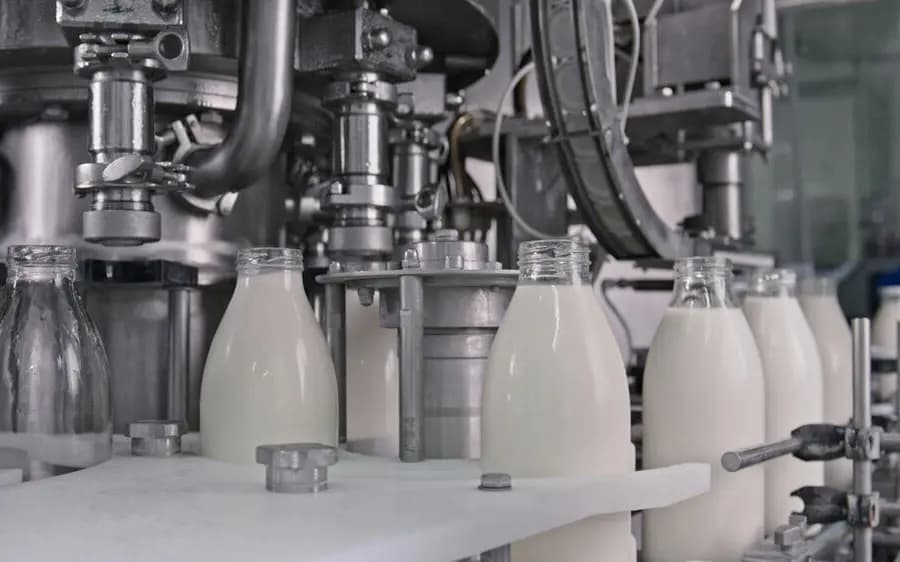
Private dairies have built procurement networks, installed chilling infrastructure, expanded processing capacities, and created brands that have helped formalise consumption across urban and semi-urban India.
It is precisely this space—the so-called “open milk economy”—that is now being structurally reorganised.
The integration of 45,000 village-level collection and pooling points into cooperatives effectively means that a very large portion of the currently accessible, flexible milk pool will gradually move into a closed, institutionally controlled network.
The real shift is not in infrastructure—it is in access.
Once these centres are formalised as cooperative entities and linked upwards into multi-state structures, the nature of milk procurement changes fundamentally. Farmers who earlier had the option to sell to private players based on price, convenience, or relationship will increasingly be drawn into a system offering assured procurement, transparent pricing, and additional benefits routed through cooperative channels.
Over time, this will significantly reduce the contestable milk pool available to private dairies.
The implications become sharper when one overlays this policy direction with the existing scale and strength of the cooperative infrastructure. As per the latest available data from the National Dairy Development Board Annual Report 2024–25, the cooperative network already has an installed capacity of approximately 8.5 crore litres per day in bulk milk coolers (BMCs), about 2.4 crore litres per day in chilling centres, and nearly 11 crore litres per day in milk processing plants.
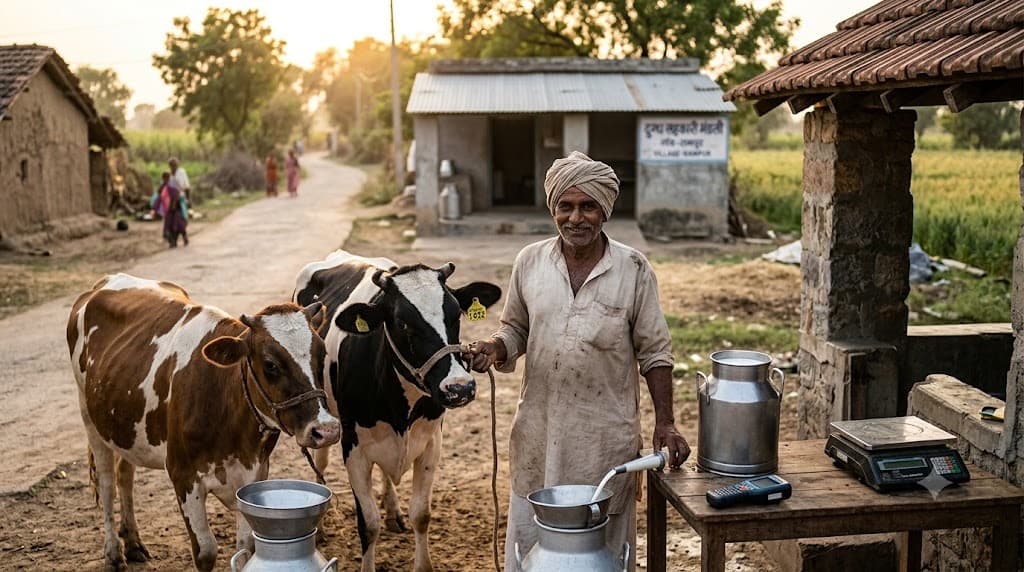
On the ground, this translates into a procurement network that currently collects around 6.75 crore litres of milk per day from nearly 1.65 crore farmers spread across 2.4 lakh villages, and markets approximately 4.5 crore litres per day as liquid milk in poly pouches.
This is not an underdeveloped system seeking scale; it is already a massive, deeply penetrated network operating below its full capacity.
The addition of new collection centres will not just expand the system—it will absorb idle capacity and tighten procurement control.
For the private sector, the risk is not theoretical; it is immediate and structural.
Milk procurement, which has been the foundation of private dairy competitiveness, is gradually shifting from an open market mechanism to a controlled channel.
Price arbitrage opportunities will shrink as cooperatives, backed by policy intent to maximise farmer returns rather than profits, set stronger procurement benchmarks. The ability of private dairies to enter new geographies and build sourcing networks will weaken as village-level entry points become institutionally aligned.
If procurement access tightens, private dairies may operate below capacity—even in a growing demand environment.
Even more concerning is the emergence of a national milk grid, where multi-state cooperatives can move milk seamlessly across regions, eliminating the geographical advantages that private players have traditionally leveraged.
There is also a regulatory asymmetry that deepens this challenge. In many parts of India, dairy cooperatives operate under frameworks where farmer groups cannot independently form milk cooperatives outside the state cooperative federation structure.
This effectively means that any new cooperative formation must be aligned with, or integrated into, the existing state-led cooperative system.
For private players, this closes an important strategic pathway.
This is not just competition—it is a structural asymmetry in access to aggregation.
The situation becomes even more skewed in states where direct or indirect subsidies are extended to cooperative-linked farmers. In such regions, the economic logic for farmers naturally tilts towards the cooperative network, leading to a progressive diversion of milk away from private channels.
What begins as a policy push for inclusion gradually transforms into a supply consolidation mechanism.
If this trajectory continues, the impact will not remain limited to procurement—it will begin reflecting across the price chain.
The real risk is not shortage of milk—but loss of access to milk.
If centralisation deepens further:
If subsidy-linked procurement expands:
If both combine:
India could move towards a dual market structure—one institutionally aligned and one residual, fragmented, and expensive.
The answer does not lie in competing head-on in procurement, but in redefining the role of private dairies within the evolving ecosystem.
First, there is an urgent need to reduce dependence on open market milk. Private players must invest in captive and semi-captive sourcing models, including long-term farmer contracts and service-led engagement.
Second, the strategic pivot towards value-added dairy is no longer optional. Categories such as cheese, whey proteins, and functional dairy offer insulation from raw milk dependency.
Third, collaborative models with cooperatives should be explored. As the cooperative system expands, it will require processing capacity, product diversification, and technology infusion.
The future may not be about competing for milk—but about collaborating for value creation.
Finally, private players must sharpen their focus on brand differentiation and consumer segmentation.
The risks are clear:
At the same time, opportunities exist:
What is unfolding is not merely an expansion of cooperatives, but a restructuring of the dairy value chain.
The question is no longer who controls processing.
The question is—who controls milk.
For the private sector, the challenge is real: a narrowing procurement base, rising cost pressures, and an evolving competitive landscape.
Yet, the future need not be adversarial.
India’s dairy growth story will require both:
Source ; Article by Kuldeep sharma Chief editor Dairynews7x7 March 28th 2026Those who recognise this shift early will not just adapt—they will redefine their role in the new dairy economy.