Logo
IndianGlobalBlogsPublicationsPodcastsMarketAboutContact
Logo
IndianGlobalBlogsPublicationsPodcasts
7News
Australian Dairy Robots Meet Cows’ First Day ResistanceMilk Producers in Coimbatore dissatisfied Over Rs1/L IncentiveStrengthening Agriculture and Allied Sector and Market AccessIndia’s Dairy Climate Paradox: Production Triumph Meets Methane Time-BombDairy sector contributes 85% of methane emission in HP

Indian Dairy News

Milk Producers in Coimbatore dissatisfied Over Rs1/L Incentive
Mar 02, 2026

Milk Producers in Coimbatore dissatisfied Over Rs1/L Incentive

Milk producers supplying to cooperative networks in and around Coimbatore have expressed dissatisfaction with the government’s recent decision to provide only an additional ₹1 per litre incentive for...Read More

Strengthening Agriculture and Allied Sector and Market Access
Mar 02, 2026

Strengthening Agriculture and Allied Sector and Market Access

Transforming India’s Livestock and Fisheries Sector Introduction India’s agricultural progress is increasingly supported by the expansion of allied sectors such as livestock, dairy, poultry,...Read More

Dairy sector contributes 85% of methane emission in HP
Mar 01, 2026

Dairy sector contributes 85% of methane emission in HP

The livestock and dairy production sector in Himachal Pradesh accounts for more than 85 per cent of the state’s annual methane emissions, a new scientific assessment has warned, cautioning that the si...Read More

DairyNews7x7
Advertisement

Latest Blogs

See More
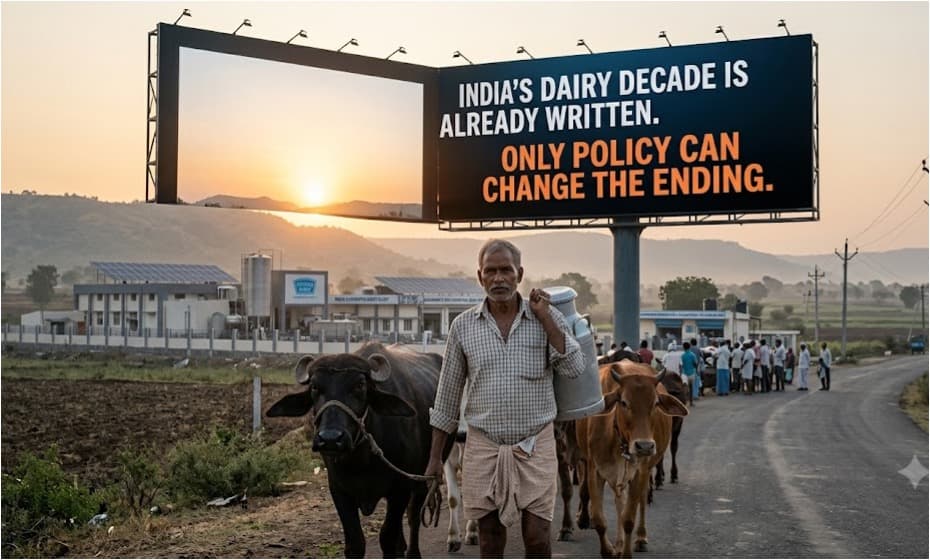
India’s Dairy Climate Paradox: Production Triumph Meets Methane Time-Bomb
Mar 02, 2026

India’s Dairy Climate Paradox: Production Triumph Meets Methane Time-Bomb

India’s rise to the top of the global dairy league board has been one of the most remarkable agricultural success stories of the 21st century. With milk production surpassing 247 million tonnes per ye...Read More

India’s First Cow Culture Museum in Mathura
Feb 16, 2026

India’s First Cow Culture Museum in Mathura

India’s first national “Cow Culture Museum” is set to be established in Mathura, Uttar Pradesh, on the campus of Pandit Deendayal Upadhyaya Veterinary Science University, announced the Uttar Pradesh B...Read More

Why India’s Dairy Needs a National Fodder Grid ?
Feb 15, 2026

Why India’s Dairy Needs a National Fodder Grid ?

Recently, I moderated the Farmer's session at 52nd DIC. While deliberating on pathways for Kerala to move towards milk self-reliance, K S Mani, Chairman of Milma, articulated a compelling thought: jus...Read More

Coliform in Milk -Look Beyond Brands to Cold Chain Gaps
Feb 12, 2026

Coliform in Milk -Look Beyond Brands to Cold Chain Gaps

Recent independent lab tests have triggered alarm over coliform bacteria and high total plate counts (TPC) in popular pouch milk brands — Amul Taaza, Amul Gold, Mother Dairy and Country Delight...Read More

Global Dairy News

Australian Dairy Robots Meet Cows’ First Day Resistance
Mar 02, 2026

Australian Dairy Robots Meet Cows’ First Day Resistance

On a southwest Victorian dairy farm transitioning to fully automated systems, farmers discovered a rudimentary truth of automation in agriculture: cows don’t immediately take to technology. As one far...Read More

US Dietary Guidelines Put Full-Fat Dairy in Spotlight
Mar 01, 2026

US Dietary Guidelines Put Full-Fat Dairy in Spotlight

The 2025–2030 Dietary Guidelines for Americans — jointly issued by the **US Departments of Health and Human Services and Agriculture — have elevated full-fat dairy products (like whole milk, fu...Read More

Ukraine Dairy in Deepest Crisis, Producers Urge Rescue Plan
Mar 01, 2026

Ukraine Dairy in Deepest Crisis, Producers Urge Rescue Plan

Ukraine’s dairy industry is currently experiencing the deepest crisis in recent years, with industry representatives warning that without swift government action up to 20 % of industrial milk producti...Read More

DairyNews7x7
Advertisement
Dairy News 7x7

Your trusted source for all the latest dairy industry news, market insights, and trending topics.

FOLLOW US
CATEGORIES
  • Global News
  • Indian News
  • Blogs
  • Publications
  • Podcasts
SUBSCRIBE TO OUR NEWSLETTER

Stay informed with the latest updates and trending news in the dairy industry.

No spam, unsubscribe at any time

GET IN TOUCH
C-49, C Block, Sector 65,
Noida, UP 201307
+91 7827405029dairynews7x7@gmail.com

© 2026 Dairy News 7x7. All Rights Reserved.

Terms of ServicePrivacy Policy
Prefer Us
Prefer Us

Dairy industry : “Change before you have to.”

By Kuldeep Sharma•Published on July 01, 2022

Dairy industry : “Change before you have to.”
Prefer on

Today is July 1st , 2022. A day which is bringing a big change in the Indian dairy and food industry through regulatory measures.. There are three major departments which regulate all food business in India . These are Food authority ( FSSAI), Goods and Service tax ( GST) and Central Pollution Control Board ( CPCB). The dairy industry is geared up to implement key regulations from all three departments from today onwards. Let us pick these notifications one by one.

By the way SOS, a signal for distress signal was also introduced on July 1st 1908.

Yesterday the GST council meeting removed the exemptions on GST for prepackaged, relabelled and packaged buttermilk, curd,Lassi and Panir. This means that we may expect imposition of 5% of gst on essential healthy foods like Buttermilk-Dahi-Lassi-paneer in packed-or-loose-format. In rural India buttermilk is a household product and is distributed freely as a symbol of love and affection. In urban and semi urban India these dairy products are predominantly sold by the unorganised sector like; sweet shops, small dairy shops, vegetable markets and home delivery by milkmen. Once this exemption of 5% is removed then how will the government be able to enforce tax on this unorganised-sector? Yet to be understood.

GST on Buttermilk and curd is like GST on milk itself

Dairy-sector is currently undergoing very tough times due to inflationary pressures on input costs and very high raw material cost. Most of the dairies have opted for shrinkflation and reduced volumes of Buttermilk and curd by maintaining the same price-levels. Buttermilk is truly a healthy “Make in India” response to soft drink manufacturers. Curd , buttermilk and Lassi are just an extended version of milk during summer time. “Charging GST on them is like charging GST on milk itself.” Charging gst on these products is bound to disturb the pricing ,and in the absence of coins in the market , the manufacturers will absorb it by changing the volumes slightly. Which again means new packaging and lots of wastage of existing inventory.

On the contrary, the government may not gain much as hardly 5-10% of these products are sold in the market through the organised sector. Currently GST data show that of the total 1.4 crore registrations, firms with less than ₹1.5 crore annual turnover account for 84 percent but contribute less than 7 percent of the tax collected. It simply means that even if the unorganised sector is covered through enforcement, the revenue collection is not going to be much as most of these unorganised players will trade it within 40 lakhs limits.

Gst on Ghee and Butter is still unresolved

The dairy industry was expecting a reduction of gst on Butter and ghee from 12% to 5% from the recently concluded GST council meeting. The whole market is disturbed as the tax department is unable to stop without bill sales of these products at lower prices even with their best efforts. With ghee prices at around Rs 500-600 per kgs,  a without bill sale is by default competitive by Rs 60-70 per kgs.

The GST on Dairy and milking machinery has also been increased from 12% to 18%. These equipment are bought by small farmers who have no provision for getting the gst credit . In other words if the farmers want to follow the clean milk production practices in order to produce high quality milk then he will have to spend more. Why would he do it then?

The press note says that the GST council has approved the recommendations made by the experts. I checked with the industry as well as the Indian dairy association, none of them acknowledge to be part of this decision. Then who are these experts?  The dairy industry along with 100 million farmers is here to support the government. I just request the government to be more inclusive and understand the perspective of industry also before taking such decisions.

Ban on single use plastics 

The government has banned single use plastic from today July 1st. The flavoured milk , milk shakes and Lassi in small paper carton packs will not have plastic straw anymore. This ban will leave the industry with one option of using paper straws . However the paper straws either are very costly or they are not having enough strength to pierce through these packaging. The increased prices of these straws will also be impacting the razor thin margins in Rs 5-15 SKUs.

As per Sh R S Sodhi, MD GCMMF “The intention of the government is good. But currently, our country simply does not have the capacity to manufacture paper straws which have to be imported and are 5-6 times more costly. Also, they are not as effective as plastic straws. I think that the government must give some more time till the paper straw industry is scaled up to meet the demands . The government may also understand that absence of sufficient infrastructure for plastic collection and recycling is a major issue than the use of plastic itself.

Besides, Sodhi said, plastic straws do not even account for 0.1 % of the total plastic consumption.

Packaging and Labeling regulation

Lastly the notification by the Food regulator FSSAI on packaging and labelling is also getting implemented. All the Food business operators are required to show Nutritional Indicators with RDA values , energy values , etc. The new rule of metrology for writing per unit price is also mandatory now. Even after preparing for so many months there are huge inventories of packaging material lying with the industry. Dairy industry has a large spectrum of SKUs now. Each variety of pasteurised milk itself has 5-6 different SKU on volumes, homogenised or non homogenised etc. Out of the whole product mix, hardly 10-15% are fast moving and rest are very slow moving. However the Minimum order quantity for all the packings remain the same.

Though there is a provision in which the FBO can take permission from the regulator to make use of their existing inventories, still a clear cut notification as well as an online link to submit the details of those SKUs and take the permission will be very helpful to the industry.

In the end I would like to say that India is changing and changing very fast. We may not expect reviews and roll backs very often now. Some changes are good for the nation in the wake of climate change , consumerism ;while others may need more discussions and calibrations from Indian culture and economy perspective.

Whatever the situation may be… the quote by legendary star CEO Jack Welch that ” Change before you have to ” looks so apt today on July 1st 2022.

Do send your comments and suggestions to make implementation of regulations in the dairy sector in a more industry friendly manner.

Source : A Dairy blog by Kuldeep Sharma, Chief editor Dairynews7x7.com , Write back to us at dairynews7x7@gmail.com

Stay Updated

Get the latest dairy industry news directly in your feed.

Prefer Us on Google Search

Swipe to continue reading

Previous Article

Next Article