Logo
IndianGlobalBlogsPublicationsPodcastsMarketAboutContact
Logo
IndianGlobalBlogsPublicationsPodcasts
7News
India’s Dairy Sector Rethinks Supply Trust & Nutrition StrategyU.S. Dietary Guidelines Overhaul Raises Dairy, MeatYear end review of Animal Husbandry and Dairy for the year 2025Fog & Frost Pose New Risks to Agriculture & Dairy in PunjabNandini Adopts AI-Based Product Counting to Boost Dairy Operations

Indian Dairy News

India’s Dairy Sector Rethinks Supply Trust & Nutrition Strategy
Jan 09, 2026

India’s Dairy Sector Rethinks Supply Trust & Nutrition Strategy

India’s dairy industry — long anchored in high production volumes but thin value realisation — is undergoing strategic recalibration around supply reliability, consumer trust and long-term nutrition v...Read More

Year end review of Animal Husbandry and Dairy  for the year 2025
Jan 09, 2026

Year end review of Animal Husbandry and Dairy for the year 2025

Hon'ble Prime Minister inaugurates Regional Center of Excellence (CoE) for Indigenous Breeds established at Motihari with an investment of Rs 33.80 crore. Genotyping of 75000 animals from the first...Read More

Fog & Frost Pose New Risks to Agriculture & Dairy in Punjab
Jan 08, 2026

Fog & Frost Pose New Risks to Agriculture & Dairy in Punjab

Persistent dense fog and dropping temperatures across Punjab — especially around Ludhiana and surrounding districts — are raising fresh concerns for both agriculture and dairy sectors, as winter weath...Read More

DairyNews7x7
Advertisement

Latest Blogs

See More
From Forecast to Fact: 2025 Lessons, 2026 Dairy Outlook
Jan 01, 2026

From Forecast to Fact: 2025 Lessons, 2026 Dairy Outlook

As we step into 2026, it is worth pausing to reflect on how the Indian dairy sector navigated the challenges of 2025 and how closely reality tracked the forecasts I outlined in the first blog of last...Read More

India–NZ Dairy FTA: Safeguards or Silent Slippages?
Dec 26, 2025

India–NZ Dairy FTA: Safeguards or Silent Slippages?

The recently concluded India–New Zealand Free Trade Agreement (FTA) marks an important milestone in bilateral trade, while carefully ring-fencing India’s sensitive dairy sector. Under the agreement, c...Read More

Vision 2047: India’s Dairy Development Roadmap
Dec 21, 2025

Vision 2047: India’s Dairy Development Roadmap

As India moves steadily toward Vision 2047, the dairy sector stands at a strategic inflection point. From being a food security instrument in the decades following Independence, dairy has evolved into...Read More

Global Dairy Dynamics: Innovation, Sustainability & Inclusion
Dec 18, 2025

Global Dairy Dynamics: Innovation, Sustainability & Inclusion

The International Dairy Processing Conference (IDPC) 2026, organised by the Trade Promotion Council of India (TPCI) at Yashobhoomi Convention Centre, Dwarka, New Delhi on 7 January 2026, will serve as...Read More

Global Dairy News

U.S. Dietary Guidelines Overhaul Raises Dairy, Meat
Jan 09, 2026

U.S. Dietary Guidelines Overhaul Raises Dairy, Meat

The newly released 2025–2030 U.S. Dietary Guidelines, unveiled by Health Secretary Robert F. Kennedy Jr. and the Department of Agriculture, represent a major shift in federal nutrition policy, placing...Read More

Spoiled Dairy Becomes 3D Printing Plastic
Jan 07, 2026

Spoiled Dairy Becomes 3D Printing Plastic

Researchers patent a biomaterial from wasted milk proteins, creating biodegradable 3D printing filament and a potential new revenue stream for dairy. Excess milk that once flowed down farm drains duri...Read More

Milk production declines amid rising water costs
Jan 07, 2026

Milk production declines amid rising water costs

Dairy producers across Victoria are facing a tightening operating environment, with declining milk flows and escalating water and fodder costs, according to the Dairy Australia Situation and Outlook Y...Read More

DairyNews7x7
Advertisement
Dairy News 7x7

Your trusted source for all the latest dairy industry news, market insights, and trending topics.

FOLLOW US
CATEGORIES
  • Global News
  • Indian News
  • Blogs
  • Publications
  • Podcasts
SUBSCRIBE TO OUR NEWSLETTER

Stay informed with the latest updates and trending news in the dairy industry.

No spam, unsubscribe at any time

GET IN TOUCH
C-49, C Block, Sector 65,
Noida, UP 201307
+91 7827405029dairynews7x7@gmail.com

© 2026 Dairy News 7x7. All Rights Reserved.

Terms of ServicePrivacy Policy

Creating a Risk Register for the Dairy Industry Amidst the Meta Crisis

By Kuldeep Sharma•Published on June 01, 2024

Globally , Ist Jun is celebrated as World Milk day. Dairy is a globally essential food source, consumed by over 80% of the world's population. It provides vital nutrients for people of all ages, supports millions of livelihoods through dairy farming, and contributes significantly to national economies in many countries. Happy World Milk Day to everyone!

Today, the world is experiencing a profound meta crisis, born from the unseen consequences of unchecked growth. Humanity is on a perilous path toward self-destruction. Across the globe, nations are embarking on mega projects with narrow objectives, failing to consider the broader picture that includes environmental and socio-economic impacts. The same applies to agriculture and livestock, where the quest for improved productivity and cost reduction through emerging technologies like AI and IoT is leading to farm-less or farmer-less farming.

Today, let's pause to envision the potential risks this short-sighted approach holds for our dairy sector. Our relentless pursuit of growth, without regard for the environment and changing societal dynamics, threatens the very foundation of our existence.

Meta Crisis

The meta crisis we face seems inevitable as humanity evolves into superorganisms driven by narrow goals. Our relentless pursuit of extraction, conquest, and the destruction of diverse cultures, species, and ecosystems is setting the stage for an impending disaster. In essence, mankind is unwittingly crafting the conditions for its own extinction.

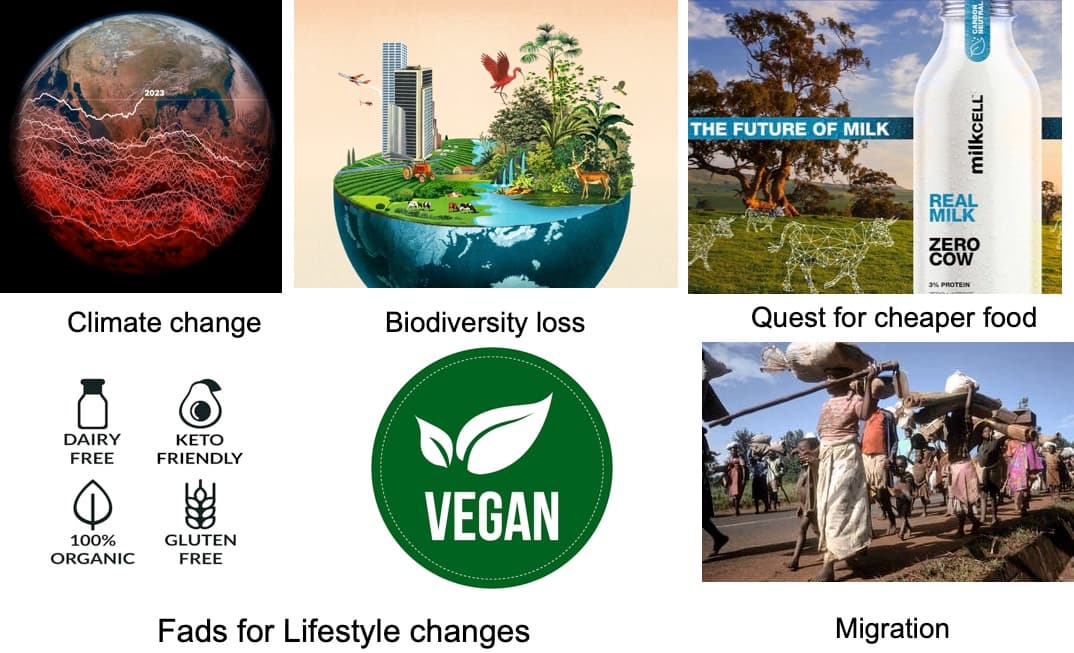
It's time to establish a risk register for our dairy industry, focusing on the critical factors that will shape its future. Key considerations must include the impact of climate change, biodiversity loss, the quest for cheaper cow-less dairy alternatives, emerging lifestyle fads, and the shift towards non-farm activities. Let's delve into each of these aspects.

Climate Change

According to the FAO, livestock is a major source of methane emissions. For every gram of milk protein produced, there are significant CO2 equivalent emissions—404 grams and 87 grams for buffaloes and cows, respectively. However, livestock also plays a crucial role in sustaining farmers globally. In India, livestock contributes nearly one-third of the total agricultural gross value addition.

With India's smallholder farming model, targeted efforts such as climate resilient breeding, balanced rations, methane blockers, and open grazing can effectively control these emissions. Let’s follow the global solutions to this crisis, as shared by the FAO.

Loss of Bio diversity

The environmental footprint of dairy farming is a growing concern due to biodiversity loss and significant resource consumption. Reducing dairy intake could save an estimated 19 billion cubic Meters of water annually, which is about 1.7% of India's total water availability. Additionally, it could free up 460 billion square meters of land each year, equivalent to the area of Spain or 32 billion trees.

Despite these environmental concerns, dairy remains a crucial source of nutrition. Animal products provide 18% of our calcium and 39% of our protein intake. Milk, in particular, is an excellent source of essential micronutrients such as Vitamin B12, galactose, phosphorus, potassium, and Omega-3 fatty acids.

Adopting best practices for manure management and implementing good dairy farming practices can significantly mitigate these environmental issues. By balancing sustainable practices with the nutritional benefits of dairy, India can continue to thrive in the dairy sector while minimizing its environmental impact.

Quest for Cheaper food for large population

Population growth presents a formidable challenge worldwide. In 1813, the global population was 1 billion. By 1913, it had increased to 1.5 billion, and by 2013, it surged to 7.5 billion. Projections now estimate that by 2113, the global population could exceed 12 billion.

According to a recent United Nations report, the demand for food to support this burgeoning population will increase by 50% by 2050 compared to 2012. To meet this demand, an additional 165 to 600 million hectares of land will be required for crop and livestock production. Alarmingly, much of this land is currently occupied by forests and other vital ecosystems.

In India, which houses 15% of the world's cattle and 60% of its buffaloes, we face a significant challenge: a 10% shortfall in total arable land needed for fodder. This scenario has driven substantial investments towards cow-less farming, leveraging economies of scale to reduce costs. Our research indicates that 2,000 precision fermentation laboratories could meet the daily per capita demand of 250 ml for the entire global population.

While the final products of such innovative methods might lack some bioactive components of traditional milk, the unsustainable nature of conventional farming, combined with investments in disruptive technologies and a shift towards more environmentally friendly and cost-effective alternatives, may catalyze a paradigm shift in the dairy industry.

It is crucial to transform dairy into a truly sustainable business, benefiting all stakeholders involved.

Emerging Food choices as Fads

Despite vegans representing only 1-2% of the global population, veganism is one of the most discussed lifestyle trends today. For many youth, it has become a way of life, particularly in India where fitness and health consciousness are on the rise. Veganism, with its focus on plant-based foods, often feels like a path to better health and well-being.

Many claims highlight the benefits of plant-based diets, such as improved heart health, reduced stress, and lower blood pressure. However, some studies point out potential deficiencies in vital nutrients like vitamin B12, iron, calcium, iodine, choline, and omega-3 fats, especially during critical life stages like pregnancy.

The conversation around diet shouldn't be about choosing sides but about creating a balanced food plate that includes both plant and animal sources, consumed in moderation. The future of dietary habits will likely see a rise in flexitarians—those who primarily follow a plant-based diet but also incorporate animal products occasionally—reflecting a more inclusive and sustainable approach to nutrition.


Swipe to continue reading

Previous Article

Next Article