Taste Technology: The Next Frontier Indian Dairy NPD Can't Afford to Ignore
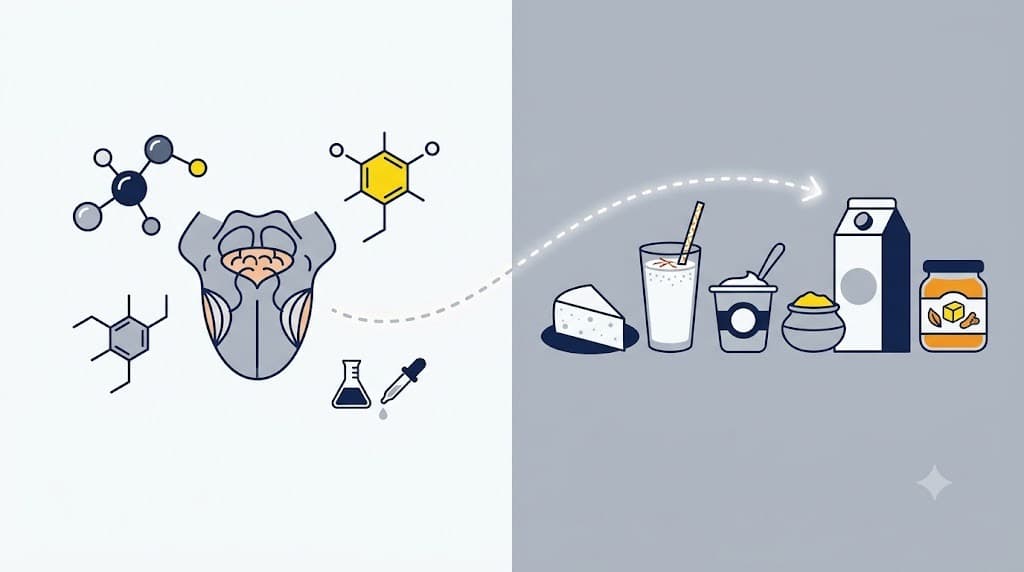
A quiet but significant shift is underway in global dairy ingredient development, and it has almost nothing to do with new proteins, new cultures, or new processing equipment. It has to do with taste — specifically, the emerging discipline of "taste technology," which treats flavour not as a finishing touch added at the end of formulation, but as a science to be engineered from the start.
The trigger for this piece was a recent announcement from Edlong, the century-old US flavour house that has built its entire identity around dairy and dairy-free taste. Edlong has launched a platform it calls "Cow to Wow" — a suite of taste technologies designed to support product development across dairy, dairy-free, better-for-you, and functional categories. The platform's core capability is masking: neutralising off-notes and bitterness that come from natural colourants, plant proteins, and functional additives, while simultaneously enhancing saltiness, sweetness, and mouthfeel. Edlong has backed this with real capital too, announcing a $10 million expansion of its Illinois facility earlier this year specifically to scale up this taste technology platform and its customer innovation centre.
Edlong is far from alone. Givaudan has built an extensive masking portfolio specifically for plant-based dairy, working from the finding that a majority of consumers who avoid plant-based milk do so because they simply don't like how it tastes — and using analytical chemistry to identify the exact compounds responsible for off-notes before engineering a targeted fix. IFF runs a comparable platform under its FlavorFit banner, aimed squarely at the bitterness, astringency, and metallic linger that show up in high-protein dairy and fortified beverages. Industry coverage of high-protein dairy formulation has been blunt about why this matters: simply adding more protein to a product is no longer good enough, because it routinely introduces grainy texture, chalkiness, and bitterness that undoes the appeal a "high-protein" claim is supposed to create in the first place.
Why This Isn't Just a Western Formulation Problem
It would be easy to file this under "interesting but not immediately relevant to India" — except that every consumer trend driving demand for taste technology in the West is already visible in the Indian dairy market, just a few years behind.
Consider what's happening on Indian shelves right now: a rapid proliferation of high-protein dairy products — protein-fortified milk, high-protein curd and paneer, whey-based beverages — chasing the same fitness-and-nutrition wave that's reshaping Western dairy. Consider the parallel rise of plant-based and hybrid dairy alternatives, still a smaller category in India than in the US or Europe, but growing, and carrying the exact same off-note challenges — beany, grassy, chalky, metallic — that global flavour houses have spent years engineering around. And consider the "better-for-you" reformulation wave — reduced sugar, reduced fat, added functional ingredients — that inevitably strips out some of the indulgence a product needs to retain repeat buyers.
Every one of these trends creates the same underlying formulation problem that taste technology exists to solve: how do you deliver a nutritional or functional promise without asking the consumer to trade away taste to get it? Global research on plant protein flavour chemistry is unambiguous that this isn't a minor tweak — compounds like hexanal and pentanal, responsible for classic "beany" off-notes in plant proteins, can be detected by consumers at levels as low as five parts per billion. That is not a problem solved by a pinch of vanilla flavouring. It requires the same rigour — sensory science, analytical chemistry, targeted masking — that global players are now industrialising into platforms.
The Gap in Indian Dairy NPD
Here is where I'll speak plainly from four decades of watching new product development happen — and often fail to happen well — in Indian dairy companies, cooperatives, and startups. Product development in this sector has historically been driven by process and formulation expertise: getting the fat, SNF, and protein numbers right, getting the process parameters right, getting the shelf life right. Taste has usually been treated as something you get right through trial and error, tasting panels, and an experienced formulator's palate — not as a distinct technical discipline with its own tools, its own science, and increasingly, its own dedicated platforms.
That approach worked reasonably well when the category was simple — milk, curd, paneer, ghee, with limited functional complexity. It works far less well when a product needs to be high-protein and taste indulgent, or dairy-free and taste authentically like dairy, or reduced-sugar and still taste like the full-sugar version consumers grew up with. These are precisely the multi-constraint formulation problems that taste technology platforms are built to solve, and precisely the problems where Indian NPD teams — even well-resourced ones — often don't have in-house sensory science or flavour chemistry capability to match the ambition of what they're trying to launch.
This is not a criticism of Indian dairy innovation, which has been resourceful and commercially sharp in plenty of other respects. It's an observation that as the category matures — as more Indian consumers demand protein, functional benefits, and clean labels without sacrificing taste — the formulation toolkit needs to mature alongside it. Global flavour houses did not build masking platforms because it was interesting science; they built them because their customers' product launches were failing on taste, at exactly the intersection of nutrition and indulgence that Indian dairy NPD is now racing toward.
Innovation Already Underway in Indian Dairy
None of this is theoretical. Enough experimentation is already happening across Indian dairy — in cooperatives, listed players, and D2C startups alike — that the format innovation itself gives a useful preview of exactly where taste technology will need to earn its keep.
Paneer is reinventing itself beyond the block. Ananda Dairy recently introduced what it billed as India's first paneer spread, taking a category that has essentially looked the same for generations and turning it into a format built for bread, toast, and quick snacking rather than the kadhai. Hatsun Agro brought paneer into its Arokya portfolio to meet regional demand in the south, and Parag Milk Foods has built out premium paneer under its Gowardhan and Go brands aimed at the modern-retail, cloud-kitchen-adjacent buyer. Paneer slices and paneer "pops" or bite formats are a logical next step in the same direction — moving a traditionally home-cooked ingredient into the ready-to-eat, snackable space that Indian urban consumers increasingly favour. Every one of these format shifts creates a new taste and mouthfeel problem that a block of paneer never had to solve: a spread needs to hold flavour and spreadability without weeping whey, a slice needs to melt or hold shape predictably, and a snackable format needs a flavour punch strong enough to compete with the salty snacks it's really competing against.
High-protein has gone from niche to mainstream battleground, at genuine mass-market pricing. Amul's high-protein push — starting with whey-fortified lassi and buttermilk and extending to a high-protein dahi launched at roughly ₹70 for a 400ml pack delivering 25g of protein, plus a "super milk" offering 35g of protein per 250ml pack — has been explicit about the goal: bring protein out of the sports-nutrition niche and into daily vegetarian diets. Mother Dairy answered with its own "Pro" range, led by Promilk, offering 30% more protein than regular milk and priced competitively at around ₹70 a litre. What's notable is that these cooperative-led launches are now out-pricing and out-distributing the D2C protein pioneers — brands like Epigamia, Raw Pressery, and Yogabar — that originally created the category in India but are increasingly finding it hard to compete once dairy giants with existing cold chains and trust decided to enter at scale. Heritage foods Nourish + curd at Rs 75 for 25 gm protein in 400 gms tub is another remarkable launch in this category. This is precisely the battleground where taste technology matters most: protein fortification at this scale, across milk, curd, lassi, and paneer simultaneously, is a much harder sensory problem than a single premium SKU, because the grainy, chalky, bitter notes that whey and plant proteins introduce have to be solved consistently across an entire portfolio, not just once.
UF (ultrafiltered) milk with real fruit pulp and natural extracts is a format still finding its feet by companies like Provilac, Sid's farm, Akshaykalpa, etc in India but well-precedented globally, where ultrafiltration's naturally higher protein and creamier mouthfeel make it an attractive base for fruit-forward, better-for-you beverages without the stabiliser load a standard milk base would need. As more Indian processors invest in UF capability for high-protein products, pairing that base with regional fruit pulp — mango, guava, litchi, even a phalsa or jamun for a distinctly Indian profile — is a natural, underexploited next step, and one where getting the pulp-to-dairy flavour balance right without a chalky or watery finish is exactly the kind of formulation challenge taste technology platforms are built to solve.
Global flavour trend-tracking already flags matcha and mixed berries as some of the fastest-growing dairy flavour cues, showing up in coffee creamers, ice cream, and yogurt internationally as café-culture and Asian-inspired profiles cross over into everyday dairy. India has been a relatively late mover on matcha specifically, but the underlying appetite is already visible in how quickly international-inspired flavour cues — cold coffee, cheesecake, tiramisu variants — have found their way into Indian ice cream and yogurt launches over the past two years. Berries remain a safer, faster-scaling bet in the Indian context: blueberry and mixed berry already feature prominently in Amul's own high-protein shake line-up, suggesting the fruit-forward, slightly premium flavour cue is one Indian consumers are already primed for.
Flavoured butter and herbal-infused ghee are following a global pattern that Indian dairy is well placed to lead rather than follow, for once. Global ghee innovation tracking shows a meaningful share of new ghee SKUs now carrying herb, garlic, or turmeric infusions, aimed at gourmet and functional positioning rather than plain commodity ghee — and India, as both the largest ghee market and the cultural home of infusing dairy fats with ingredients like turmeric, saffron, and tulsi for functional benefit, arguably has a more authentic claim to this trend than any Western entrant chasing "Indian-inspired" positioning. The same logic extends to butter: globally, brands are experimenting with savoury and spiced butter formats well beyond the classic salted/unsalted binary, and there's no structural reason an Indian brand couldn't do the same with genuinely regional flavour cues — a curry-leaf and mustard butter, or a saffron-cardamom butter for the festive gifting season — rather than importing garlic-parmesan or cinnamon-brown-sugar profiles wholesale.
Every one of these formats shares the same underlying lesson: the format innovation is often the easy part. Indian dairy has never lacked appetite for a new SKU. What separates a format that becomes a genuine repeat-purchase category — the way Epigamia turned Greek yogurt into a ₹180 crore business by treating flavour, texture, and consumer education as seriously as the product itself — from one that launches, gets a good first trial, and quietly fades, is almost always the taste and sensory execution underneath the format idea.
The clearest recent proof of that lesson sits in the public markets. Milky Mist — the brand that pioneered branded packaged paneer in India back in the late 1990s, when selling a sealed, branded pack of something long bought loose off the neighbourhood dairy counter looked like a genuinely odd bet — went public in August 2026 in a ₹1,553 crore IPO that listed at a roughly 18% premium. What makes the listing worth citing here isn't the market debut itself, but the portfolio behind it: 22 categories and 640 SKUs built almost entirely on value-added, taste-forward products — cheese, curd, ghee, yogurt, ice cream, RTE and RTC formats — while deliberately staying out of the thin-margin liquid milk business that still anchors most of its listed peers. That product-innovation-first strategy is precisely why its margins and valuation are being benchmarked closer to an FMCG brand than a traditional dairy company. It's a live, market-validated data point for the exact argument this piece is making: taste-led, format-led innovation isn't just a marketing nicety in Indian dairy anymore — done well, it's now a genuinely investable business model.
Where This Is Heading
I'd expect three things to play out over the next few years in the Indian context. First, more Indian dairy majors and startups will start treating flavour and sensory work as a distinct specialisation worth investing in directly, rather than folding it into general R&D. Second, global flavour houses — several of whom already have a commercial presence in India — will find growing demand here specifically for masking and taste-modulation solutions, as high-protein and plant-based dairy categories scale past their early, forgiving-consumer phase into a more competitive, taste-sensitive one. Third, and most interestingly, there's a real opening for India-focused NPD and innovation partners who understand both the science of taste technology and the specific palate, price sensitivity, and category dynamics of the Indian dairy consumer — because a masking solution engineered for a European oat-milk palate does not automatically translate to what an Indian buyer of high-protein lassi expects.
That's an area we've been building capability in ourselves. Alpha Innovation, our dedicated NPD and product innovation arm, has been working through exactly this intersection — helping dairy businesses move formulation and sensory work from an afterthought to a genuine design input, particularly for the high-protein and value-added categories that are driving growth across the sector right now. It's early days in a space that's still nascent even globally, but the direction of travel is clear enough that Indian dairy NPD teams would do well to start paying attention now, rather than catching up to it in five years the way the industry has occasionally caught up to other global formulation trends late.
The Bottom Line
Taste technology is not a niche R&D curiosity — it is quickly becoming table stakes for any dairy product that has to deliver on more than one promise at once: nutrition and taste, functionality and indulgence, clean label and flavour intensity. Global flavour houses have read this shift correctly and are investing capital accordingly. Indian dairy NPD, chasing many of the same consumer trends with a few years' lag, has every reason to take the same discipline seriously — before, not after, a wave of ambitious high-protein and plant-based launches quietly underdeliver on taste and lose the repeat purchase that any successful product actually depends on.
Source : Editorial by Kuldeep Sharma Chief editor Dairynews7x7.com in Edlong's news Aug 28th 2026