Logo
IndianGlobalBlogsPublicationsPodcastsMarketAboutContact
Logo
IndianGlobalBlogsPublicationsPodcasts
7News
India’s Dairy Sector Rethinks Supply Trust & Nutrition StrategyU.S. Dietary Guidelines Overhaul Raises Dairy, MeatYear end review of Animal Husbandry and Dairy for the year 2025Fog & Frost Pose New Risks to Agriculture & Dairy in PunjabNandini Adopts AI-Based Product Counting to Boost Dairy Operations

Indian Dairy News

India’s Dairy Sector Rethinks Supply Trust & Nutrition Strategy
Jan 09, 2026

India’s Dairy Sector Rethinks Supply Trust & Nutrition Strategy

India’s dairy industry — long anchored in high production volumes but thin value realisation — is undergoing strategic recalibration around supply reliability, consumer trust and long-term nutrition v...Read More

Year end review of Animal Husbandry and Dairy  for the year 2025
Jan 09, 2026

Year end review of Animal Husbandry and Dairy for the year 2025

Hon'ble Prime Minister inaugurates Regional Center of Excellence (CoE) for Indigenous Breeds established at Motihari with an investment of Rs 33.80 crore. Genotyping of 75000 animals from the first...Read More

Fog & Frost Pose New Risks to Agriculture & Dairy in Punjab
Jan 08, 2026

Fog & Frost Pose New Risks to Agriculture & Dairy in Punjab

Persistent dense fog and dropping temperatures across Punjab — especially around Ludhiana and surrounding districts — are raising fresh concerns for both agriculture and dairy sectors, as winter weath...Read More

DairyNews7x7
Advertisement

Latest Blogs

See More
From Forecast to Fact: 2025 Lessons, 2026 Dairy Outlook
Jan 01, 2026

From Forecast to Fact: 2025 Lessons, 2026 Dairy Outlook

As we step into 2026, it is worth pausing to reflect on how the Indian dairy sector navigated the challenges of 2025 and how closely reality tracked the forecasts I outlined in the first blog of last...Read More

India–NZ Dairy FTA: Safeguards or Silent Slippages?
Dec 26, 2025

India–NZ Dairy FTA: Safeguards or Silent Slippages?

The recently concluded India–New Zealand Free Trade Agreement (FTA) marks an important milestone in bilateral trade, while carefully ring-fencing India’s sensitive dairy sector. Under the agreement, c...Read More

Vision 2047: India’s Dairy Development Roadmap
Dec 21, 2025

Vision 2047: India’s Dairy Development Roadmap

As India moves steadily toward Vision 2047, the dairy sector stands at a strategic inflection point. From being a food security instrument in the decades following Independence, dairy has evolved into...Read More

Global Dairy Dynamics: Innovation, Sustainability & Inclusion
Dec 18, 2025

Global Dairy Dynamics: Innovation, Sustainability & Inclusion

The International Dairy Processing Conference (IDPC) 2026, organised by the Trade Promotion Council of India (TPCI) at Yashobhoomi Convention Centre, Dwarka, New Delhi on 7 January 2026, will serve as...Read More

Global Dairy News

U.S. Dietary Guidelines Overhaul Raises Dairy, Meat
Jan 09, 2026

U.S. Dietary Guidelines Overhaul Raises Dairy, Meat

The newly released 2025–2030 U.S. Dietary Guidelines, unveiled by Health Secretary Robert F. Kennedy Jr. and the Department of Agriculture, represent a major shift in federal nutrition policy, placing...Read More

Spoiled Dairy Becomes 3D Printing Plastic
Jan 07, 2026

Spoiled Dairy Becomes 3D Printing Plastic

Researchers patent a biomaterial from wasted milk proteins, creating biodegradable 3D printing filament and a potential new revenue stream for dairy. Excess milk that once flowed down farm drains duri...Read More

Milk production declines amid rising water costs
Jan 07, 2026

Milk production declines amid rising water costs

Dairy producers across Victoria are facing a tightening operating environment, with declining milk flows and escalating water and fodder costs, according to the Dairy Australia Situation and Outlook Y...Read More

DairyNews7x7
Advertisement
Dairy News 7x7

Your trusted source for all the latest dairy industry news, market insights, and trending topics.

FOLLOW US
CATEGORIES
  • Global News
  • Indian News
  • Blogs
  • Publications
  • Podcasts
SUBSCRIBE TO OUR NEWSLETTER

Stay informed with the latest updates and trending news in the dairy industry.

No spam, unsubscribe at any time

GET IN TOUCH
C-49, C Block, Sector 65,
Noida, UP 201307
+91 7827405029dairynews7x7@gmail.com

© 2026 Dairy News 7x7. All Rights Reserved.

Terms of ServicePrivacy Policy

Arguing against free markets is actually disbelieving freedom itself

By Kuldeep Sharma•Published on July 17, 2023

I have been hearing the seminal quote by Mahatma Gandhi in Indian context that “Mass Production is production by masses” since I started my career in the dairy industry. It’s almost four decades and even today I find most of the policies are oriented towards protecting the farmers. I am unable to decipher at times on whether protecting the farmer is an end or means. Most of the states are supporting farmers by subsidising what they produce. I am not sure who is working to find out the underlying reasons for farmers to be inefficient and loss makers all the time.

Milk subsidy in India is ranging anywhere between Rs 2/liter to Rs 11.43/litre in different states. Even if we average it out then in the cooperative sector alone this amounts to around Rs 10 crore per day or Rs 2 per liter for the whole of the milk being collected . In total it amounts to around 3650 Crores per annum. Since last almost one and a half decade giving subsidies has gained traction. I have not seen even a single farmer coming out openly and saying that he has really become prosperous in those states. On the contrary the states which didn’t follow this formula have inclusively grown well and made fortunes for their farmers too.

Cooperative model is an entry point towards Free markets

Dairy cooperatives in a big way have contributed to the well being of farmers and made them free from the clutches of middlemen. Most of the discussions about farmers end up at milk prices. We all know that in Indian agriculture due to its fragmented nature, the costs are imputed and not computed. Dairy farming in particular caters to nutritional(subjective) as well as financial ( objective) needs of the farmers . At times looking at milk price only from a financial perspective may not show us the true picture. We do not have a market for the 100% of milk produced by the farmer in our country. The dairy data consider 50% of this milk being consumed by the farmers and balance coming to the market.

We also have a private sector which has evolved strongly since the liberalisation of our economy in 1991. They are also working shoulder to shoulder with cooperatives . They are collecting almost the same volume of milk as is being done by the public sector. The sector is also meeting the needs of the milk and milk products in all parts of the country . And the private players are also purchasing milk from the farmers . They also earn forex for the Indian government by exporting milk and milk products. In most of the cases they follow the procurement price lines as created by the government cooperatives.

Who shall fix the milk price ?

Recently I came across a notification expecting every dairy firm to purchase raw milk in Maharashtra at a particular price . This notification is considering various factors of production at the farmer’s end. On the other side the processors also have their rationale behind existing milk prices. They are considering their own factors of production as well as impact of local and global dairy market dynamics . I am not commenting on either point of view.

But both sides would probably agree that the world has become a more complex place over the last 75 years. And businesses have become ever more complicated enterprises that need to balance many different priorities.

I analysed the situation from the first quarter of CY2022 till now on prevailing market dynamics in Maharashtra. The objective was to find relationships between milk price being paid and prices of key dairy commodities in India and abroad. I consider that in Maharashtra state the private sector has a significantly higher share in milk procured from the farmers. Private sector in Maharashtra also manufactures huge quantities of SMP, Butter and ghee apart from the cheese .

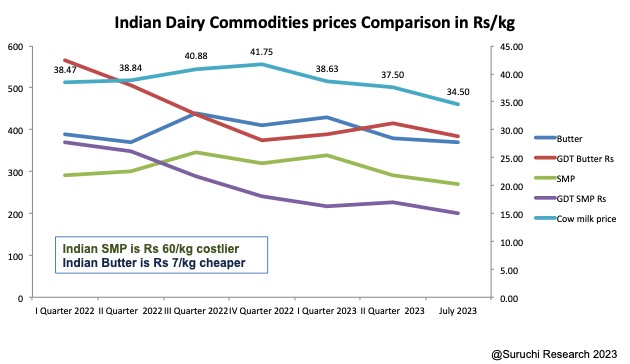
The following illustration shows quarter wise milk procurement prices on top . It also shows the market prices of SMP and Butter in India and at GDT auctions below milk prices.
What wrong is the private sector doing ?

  1. Currently Indian SMP is Rs 60/kg costlier than the global rates
  2. Butter is almost at par with the global prices
  3. Both SMP and Butter are available in huge stocks
  4. Both SMP and Butter have a frail demand since the last three months.
Let us analyse this illustration on a quarterly basis. The year 2022 started with lots of hopes for a booming market for dairy commodities due to shortage of the commodities. The global markets were also bullish. There was a good margin in exports in both SMP and Butter. The situation began to change from the third quarter onwards when the global prices started to move down.

By that time commodity prices in India started to fetch good prices. The commodity prices in India were reaching new heights due to shortage of milk in the flush-season of fourth quarter 22 . The same sentiment remained in the first quarter of 2023 also. However by the fag end of first quarter in 2023 the momentum of commodity prices got slowed down.

Interestingly the milk supplies across the nation started to improve from first quarter 23 onwards which is happening till date. The processors never hesitated to pay good prices to the farmers when the business was good. They bought milk upto Rs 42 per kg landed at their plant. The situation changed from second quarter 23 onwards . Due to the erratic weather, huge stocks of dairy commodities got built up. The sales of ice cream, dahi, buttermilk which are major consumption centres for the commodity got impacted.

The private sector did not say no to the famers

If we doubt the intent of the processors then he has never said no to the farmers. He not only bought milk but continuously bought it also under all types of situations . We must also appreciate that he is not getting any interest subvention over his stocks. He is not even sure of the future of the stocks which he is building up.

The processor is living in hope. He is also exuding the same hope to millions of farmers in the state. The profitability in the dairy sector across the product range is not similar. Nowadays for most part of the year it is higher for the dairies selling fresh milk products. Rather poly-pack milk is amongst the most value added dairy products in case you have a stable market. So some of the processors who are working at a small to medium scale may have some deep pockets. They may afford the suggested price as per the notification. But the large players who have been buying milk throughout the year including the flush are in bad shape today.

The industry requires freedom

I believe that our industry has matured enough to be inclusive and keep its social objective also fulfilled. It is very difficult to assess the complex nature of milk pricing without spreading the chips on a global canvas as well as the manufacturing factor of production too.

That reminds me of Milton Friedman and his epochal essay, ” The social Responsibility of Business is to increase its profits “. We need to evolve and start appreciating the meaning of profit. There must be ways of governance to see that the social interests of the stakeholders are protected.
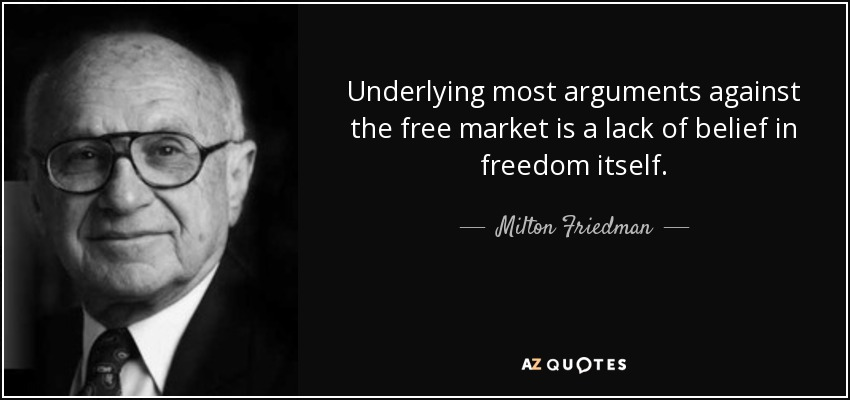
We are the largest milk producer of the world and we also aspire to be the largest exporter . However, looking at the nature of dairy farming in our country we need to work to remove all the constraints which makes milk production unprofitable. The government is doing so much to revolutionise dairy farming. The last thing that the industry needs is freedom. Let us plan to build free markets in agriculture too. We will have to open up one day….then why not in the near future..why not today !

Source : A dairy blog by Kuldeep Sharma Chief editor Dairynews7x7.com

Swipe to continue reading

Previous Article

Next Article