Latest Blogs
See More


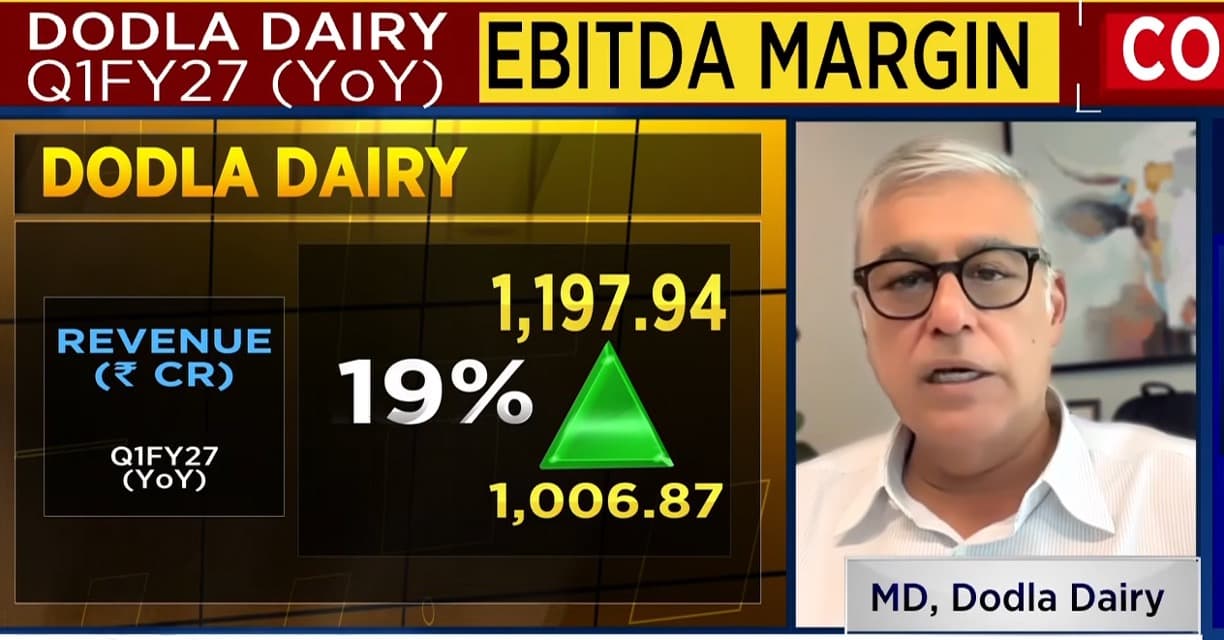
In an interview with CNBC-TV18, Managing Director Sunil Reddy said the company had initially chosen to absorb higher milk procurement costs instead of passing them on to consumers, expecting prices to ease with the onset of the monsoon. However, that assumption has not played out.
"We did not pass on the cost increases because we expected procurement prices to moderate after the monsoon. That has not happened. Procurement volumes have not increased as much as we anticipated, possibly because of the El Niño effect," Reddy said.
The strategy weighed on earnings during the quarter. While revenue rose 19%, the company's earnings per share (EPS) fell about 35% as gross margins contracted amid rising input costs. Packaging material costs also surged by nearly 50%, adding further pressure on margins.
The management expects the price hikes to offset higher procurement costs and restore profitability over the remainder of the financial year.
Despite the weak start to FY27, the company maintained its operating guidance, projecting:
The OSAM business is expected to contribute around ₹400 crore in revenue, with EBITDA margins of 4-5%.
The Orgafeed business is expected to generate nearly ₹200 crore in annual revenue, while maintaining EBITDA margins of 12-13%.
Both businesses are expected to strengthen Dodla Dairy's diversified revenue base over the next few years.
According to Reddy, the two largest investments include:
The plant will have a processing capacity of 10 lakh litres per day, equivalent to nearly 40-50% of Dodla Dairy's current processing capacity.
Initially, the company expects to procure an additional 2-3 lakh litres of milk per day, with volumes ramping up gradually as the business scales.
The company estimates that the facility could contribute ₹400-500 crore of additional revenue during its first two years of operations.
Over the longer term, once capacity utilisation improves, Maharashtra alone has the potential to generate ₹2,000-2,500 crore in annual revenue, Reddy said.
Combined with the ₹400-crore revenue contribution expected from OSAM, the ongoing expansion projects are expected to deliver ₹800-1,000 crore of additional revenue over the next two to three years.
Although the new geographies may initially operate at relatively lower profitability, with EBITDA margins of around 5-6%, management expects the investments to generate healthy returns on capital employed over time.
Reddy said the sharp increase was partly seasonal.
Compared with the same period last year, an extended summer boosted demand for products such as ice cream, while lower bulk milk sales also increased the proportion of value-added products in the overall revenue mix.
Even so, the company reiterated its long-term strategy of increasing the contribution of value-added products by 1-2 percentage points every year.
Growth in individual categories has also remained strong.
Paneer production has increased from around 2 tonnes per day to 4-5 tonnes daily, while ice cream volumes have also expanded meaningfully.
Management believes continued growth in these categories will support profitability over the medium term.
The investment of approximately ₹11-12 crore comes at a time when Sid's Farm has grown rapidly, generating around ₹240 crore in revenue after expanding nearly 2-3 times over the past three years.
Asked why Dodla did not acquire a larger stake, Reddy said the investment was intended as a learning opportunity rather than a financial bet.
"We don't fully understand that space yet. We want to see how it evolves before making a larger commitment," he said.
According to Reddy, emerging dairy categories such as high-protein products are still at an early stage of consumer adoption and require time to become mainstream.
Drawing a parallel with curd, he noted that it took five to seven years for consumers to shift from preparing curd at home to purchasing it regularly from the market.
Rather than making a large upfront investment, Dodla intends to monitor Sid's Farm's execution and customer traction before committing more capital.
Reddy said the company would review Sid's Farm's performance every two years.
"If their growth continues as projected, we can always increase our stake later rather than investing aggressively at this stage," he said.
Its Maharashtra expansion, expected to become operational by March 2027, alongside the integration of OSAM and a measured entry into premium dairy and D2C through Sid's Farm, underscores management's strategy of balancing growth with disciplined capital allocation.
Review article on Interview of Sunil Reddy MD Dodla Dairy by CNBC TV 18- Watch it here.
Source : Dairynews7x7 July 29th 2026