Latest Blogs
See More
Indian Dairy News
DairyNews7x7
Global Dairy News


DairyNews7x7
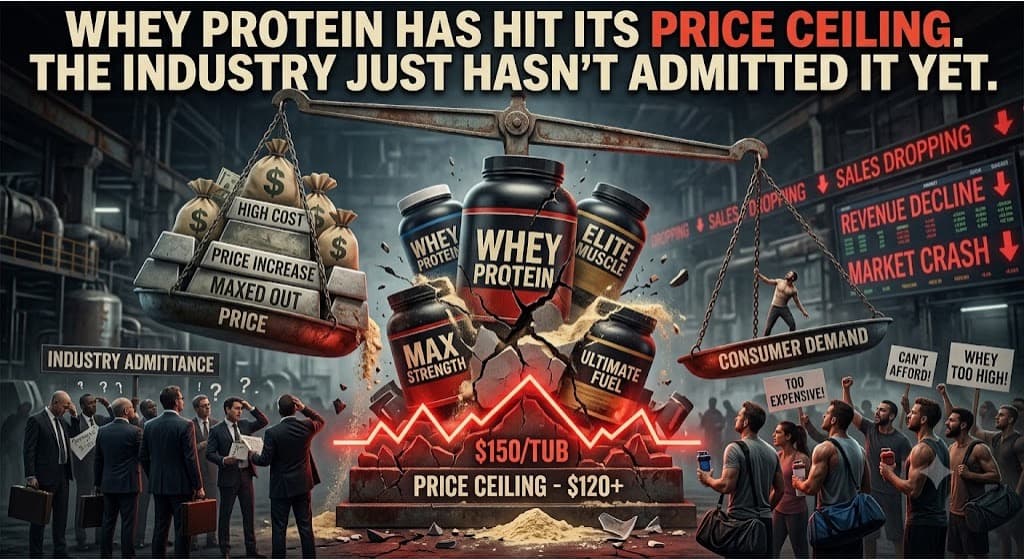
Ashni is 43, works in marketing, and has trained at the gym long enough that a protein scoop is as routine as her morning coffee. For years she paid around ₹2,000 for a 1 kg tub of whey. Today that same tub costs upward of ₹3,200. Her response wasn’t to pay up — it was to switch. Curd, paneer, ready-to-drink shakes have quietly replaced a chunk of what used to be pure whey.
Multiply Ashni by a few million urban Indians, and you have the real story hiding underneath all the good news headlines about India’s protein boom.
Read together, this looks like an industry riding a demand supercycle. Read more carefully, it’s actually an industry quietly repricing itself out of its core product.
That distinction matters enormously for how the industry should read this moment. A consumer who quits a category because they’ve lost interest is a demand problem. A consumer who quits a price point but stays in the category is a pricing and formulation problem — and it’s fixable, but only if the industry treats it as one.
Fitness enthusiasts absorbed the first leg of price hikes because whey is their category of identity. But the mainstream households the industry is now chasing — the ones iD Fresh, Sid’s Farm and Akshayakalpa are explicitly targeting beyond the gym crowd — have far thinner tolerance. For them, protein has to compete with dal, eggs, milk and paneer on a rupee-per-gram basis, not just a fitness-marketing basis. Once a pack crosses their comfort threshold, they don’t negotiate — they simply substitute, silently and permanently.
That’s the ceiling. And every brand quoted above is, whether they say it explicitly or not, already building around it: ultrafiltration instead of added whey, protein folded into everyday staples instead of sold as a standalone supplement, dairy-native protein concentration instead of imported ingredient dependence.
In other words, the industry could win on margin per unit and lose on units sold — and end up worse off on total value capture than if it had held the affordability line in the first place. Plant proteins — pea, soy, and increasingly local pulse-based ingredients — are the quiet beneficiaries waiting on the sidelines. They’re not yet a mainstream threat in India the way they’ve become in parts of the West, but the cost gap between whey and plant protein ingredients is widening in plant protein’s favour globally. If that price gap keeps growing and Indian plant-protein supply chains mature even modestly, the switching Ashni is doing today at the retail shelf could become a formulation decision boardrooms make tomorrow.
The brands already doing this — Epigamia’s ultrafiltration bet, iD Fresh’s protein-in-staples strategy, Akshayakalpa’s capacity investment — are not just chasing a trend. They’re hedging against the ceiling. The rest of the industry should read Ashni’s ₹1,200 price jump not as a one-off consumer complaint, but as the market’s honest verdict on where the line actually sits.
Read the full story which inspired us --here
Review article by Kuldeep Sharma Chief editor Dairynews7x7