Latest Blogs
See More


China plays a critical role in global dairy markets as the world’s largest importer, and it is eagerly developing pathways to grow domestic production. According to a recent dairy report by Rabobank, the country’s self-sufficiency rate swings between 70% and 80% and will likely not increase substantially, as domestic dairy production will not satisfy rising demand in the long run. As a result, China will remain heavily engaged in the global dairy trade as its import gap widens.
Rabobank forecasts milk supply to expand from 41.5 million metric tons in 2023 to 47.4 million metric tons liquid milk equivalent (LME) in 2032, with an average compound annual growth rate (CAGR) of 1.5% by volume. At the same time, China’s annual demand is expected to grow 2.4% on average between 2023 and 2032, with dairy consumption reaching 62.2 million metric tons LME by 2032. “China will continue to have a significant role in the global dairy industry, with a further widening of the import deficit expected. In 2032, imports are likely to reach 15 million metric tons LME,” explains Michelle Huang, Dairy Analyst at Rabobank
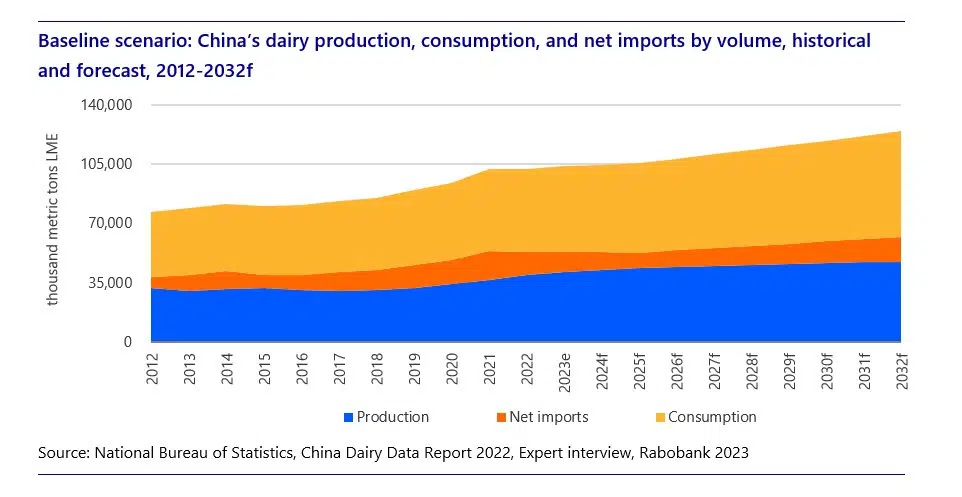
But there are some key factors to watch that may impact the import gap – particularly on the domestic supply side. For example, substantial investments in productivity and cost-efficiency improvements could further reduce China’s reliance on imports, particularly of milk powders that are typically used to produce flavored milk drinks and infant and adult milk powders.
Source : Morning Agclips Aug 23rd 2023