White Gold, Wasted Gold: Should India's Paneer Whey Fuel Cars Instead of Bodies?
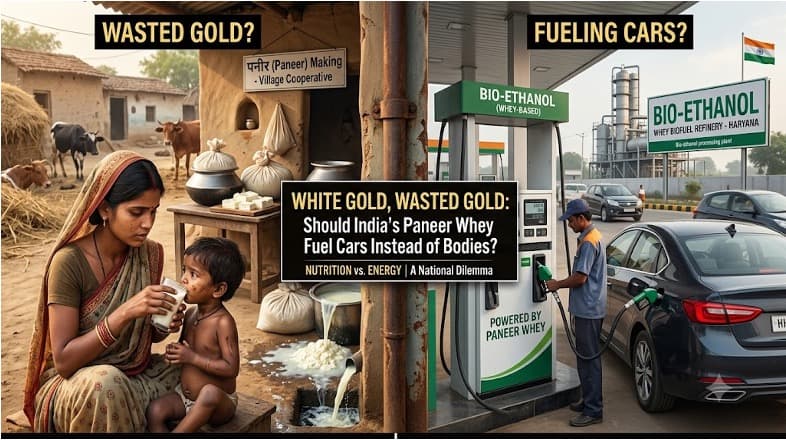
A lab in Scotland just handed the global dairy industry a headache — and it's one India should be paying very close attention to.
Researchers at Heriot-Watt University, working with the start-up Take Root Bio, have cracked a process that ferments the sugars in whey into bioethanol for vehicles and home heating. On paper, it's a classic upcycling win-win: a byproduct nobody wants, a landfill and effluent problem solved, a renewable fuel created. Dairy Reporter broke the story on August 3, and buried in it is the line that should really make Indian dairy planners sit up — whey protein prices have risen roughly fivefold since 2023, crossing €25,000 a tonne, on the back of a global protein supercycle. Bioethanol is now a second buyer walking into an already tight whey market and bidding the price up further.
So here's the uncomfortable question for India: we are sitting on millions of tonnes of whey that mostly goes down the drain — quite literally — while the rest of the world is fighting over it like it's crude oil. Should we be building whey-to-protein plants, whey-to-ethanol plants, or is that even the right binary to be asking?
Let's disrupt the comfortable narrative a bit.
The Global Signal: Whey Has Become a Commodity, Not a Waste Stream
For decades, whey was cheese-making's embarrassing cousin — high in biological oxygen demand, expensive to treat, and mostly dumped, fed to animals, or spray-dried into low-value powder. That era is over. Global whey output runs somewhere between 160–190 million tonnes a year, and by some estimates half of it is still discarded without meaningful recovery. But the economics flipped hard once the protein boom (sports nutrition, GLP-1-adjacent appetite for high-protein foods, infant formula, clinical nutrition) collided with tightening milk supply. Whey protein concentrate and isolate went from commodity byproduct to strategic ingredient, and now bioethanol wants a seat at the table too.
That's the backdrop. Now zoom into India — because our whey story is structurally different from Europe's, and that difference changes the entire calculus.
India's Paradox: World's Largest Milk Producer, Chronic Whey Protein Importer
India produces roughly 239 million tonnes of milk a year — nearly a quarter of global output. You'd expect us to be a whey protein powerhouse. We're not. India meets less than 20% of its domestic whey protein requirement from domestic production; the rest is imported sweet whey powder and WPC/WPI from the EU, New Zealand and the US, even as we drain millions of tonnes of whey every year.
The reason is structural, and it's the crux of this article: most of India's whey isn't sweet whey — it's acid whey.
Western dairy is built around rennet-coagulated cheese, which produces sweet whey (pH ~6.0–6.6) — clean, protein-friendly, and ideal feedstock for ultrafiltration into WPC/WPI. Indian dairy is built around paneer, chhena and dahi — acid- and heat-coagulated products, made by curdling with citric acid, lactic acid or sour whey itself. This produces acid whey (pH ~5.2-5.7), where a chunk of the whey protein has already been denatured by the heat-and-acid combination and complexed with casein micelles during coagulation. Acid whey is notoriously difficult and capital-intensive to process into mainstream WPC80/WPI-grade protein — the very reason so much of it is simply discharged, sold as animal feed at near-zero value, or used in low-value beverages.
Estimates of the scale vary wildly depending on what's being counted — liquid whey volume alone from paneer and chhena is pegged at roughly 3–5 million tonnes a year, but if you count total dilute acid-whey liquor generated (roughly 4-5 litres of whey per kg of paneer produced), the number balloons toward 08–11 million tonnes. Either way: this is not a rounding error. This is a multi-million-tonne annual stream of a now-precious commodity, mostly going nowhere.
So — Protein or Fuel? Let's Run the Actual Numbers
This is where most "whey valorisation" pieces get lazy and just say "both are good, let's do everything." Let's not do that. Let's actually compare.
Route 1: Whey Protein. At €25,000+/tonne (roughly ₹22–24 lakh/tonne at current rates) for whey protein concentrate/isolate, this is by far the higher-value route — if the whey can be processed into food/pharma-grade protein. But that "if" is doing enormous work in India's case. Acid whey's low pH, higher mineral/ash content, and protein denaturation make it a poor substrate for conventional WPC/WPI membrane processing. You either need pH correction and specialised processing (capital-heavy, and still yields lower-grade protein than sweet whey), or you route it into lower-value uses — beverages, lassi/chaas bases, bakery applications — which don't come close to capturing €25k/tonne economics.
Route 2: Bioethanol. This route doesn't care about pH or protein denaturation — it only cares about lactose, the sugar, which acid whey has in similar concentration to sweet whey (roughly 4.5–5% by weight). That's the disruptive insight hiding in the Heriot-Watt story: bioethanol may actually be the more honest, more scalable use case for India's acid whey specifically, precisely because it sidesteps the protein-extraction problem that acid whey creates.
The Conversion Factor: What Does a Tonne of Whey Actually Yield?
Here's the number most articles skip, so let's nail it down.
The theoretical stoichiometric yield of ethanol from lactose fermentation is about 0.538 g ethanol per gram of lactose (roughly the same as glucose fermentation, since lactose splits into glucose + galactose). In real fermentation systems, published yields range widely depending on the organism and process:
- Basic/unoptimised systems (e.g., wild lactose-fermenting fungi/yeast on raw whey): ~35% of theoretical — around 0.35 g ethanol/g lactose
- Engineered yeast/bacteria on whey permeate: 45–65% of theoretical
- Optimised, pH-controlled bioreactors on concentrated whey permeate: 80–95%+ of theoretical, with ethanol titres up to 8–9% v/v
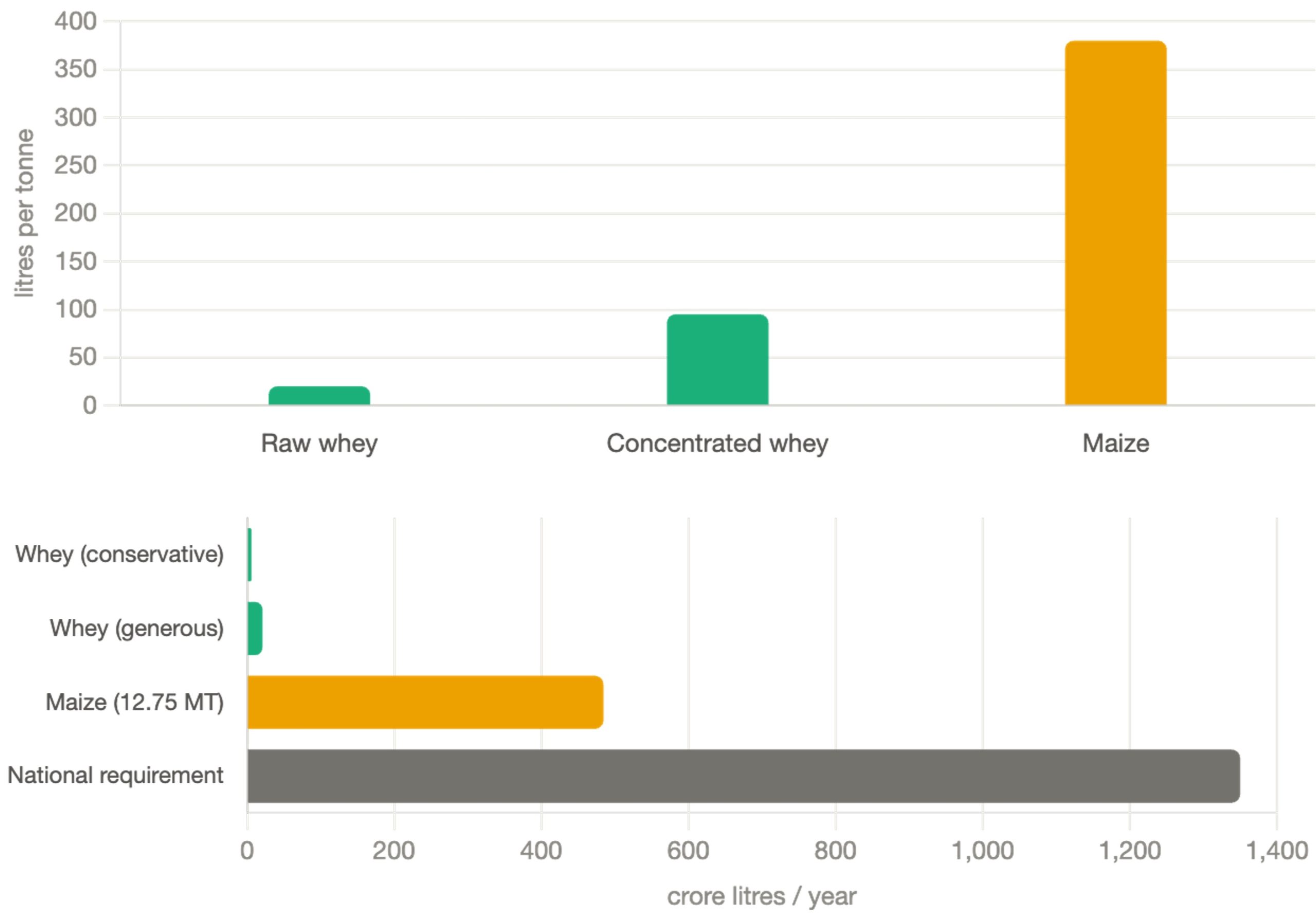
Translating that to tonnage, for raw, un-concentrated paneer/chhena whey at roughly 4.5–5% lactose content, a realistic practical yield works out to approximately 15–25 litres of ethanol per tonne of whey. If the whey is first concentrated (via reverse osmosis, standard practice in whey-to-ethanol plants abroad) to 150–170 g lactose/litre before fermentation, yields per tonne of that concentrate rise to 80–110+ litres — but that concentration step itself needs capital and energy, and only makes sense at a scale most Indian paneer units simply don't have.
Compare that to the number the Indian ethanol industry actually lives by: roughly 380 litres of ethanol per tonne of maize (based on the 12.75 million tonnes of maize allocated for ethanol in 2024–25 yielding an estimated 484.5 crore litres). Maize is roughly 15–25x more ethanol-dense per tonne than raw whey. That gap is the single most important number in this entire debate, and it's the one the "whey can save us from maize" narrative conveniently ignores.
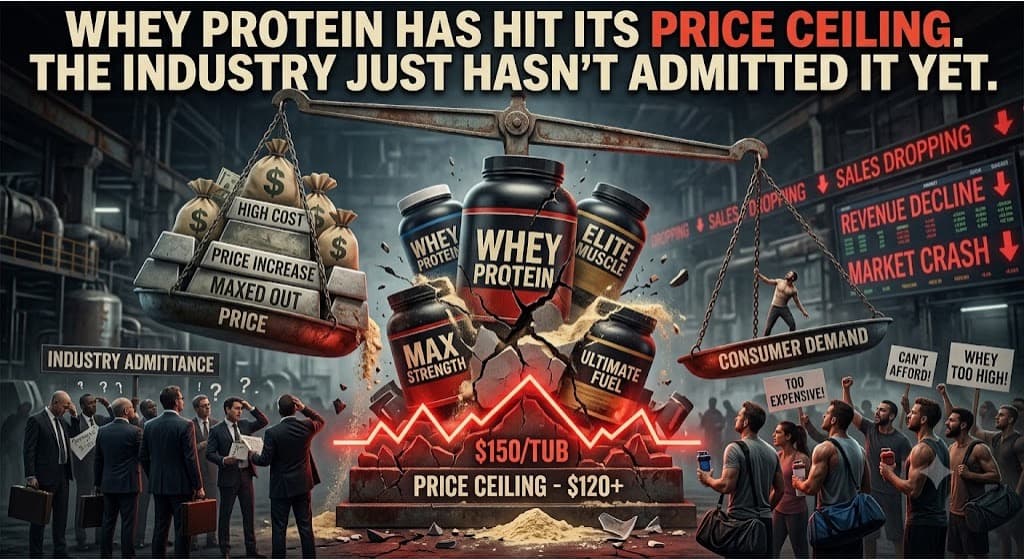
Read this also : Whey Protein Has Hit Its Price Ceiling. The Industry Just Hasn’t Admitted It Yet
Would Whey Ethanol Actually Take Pressure Off Maize?
Let's be honest about the arithmetic, because disruption without arithmetic is just hype.
- India's conservative whey pool (~3 million tonnes/year) at ~20 litres/tonne yields roughly 6 crore litres of ethanol a year. (Considering around 30% of whey being used for ethanol production)
- The more generous acid-whey-liquor estimate (~10 million tonnes) at similar yields could stretch to ~20–22 crore litres.
- India's grain-based ethanol supply target alone (from just 12.75 MT of maize) delivers close to 484.5 crore litres, and the total national ethanol requirement for blending plus industrial use is around 1,350 crore litres a year, rising further as the country pushes toward E22 and eventually explores E85 for flex-fuel vehicles.
So even the optimistic whey scenario covers somewhere between 0.5% and 4% of India's ethanol requirement. That is not a maize substitute at a national level — not even close. Anyone selling "whey will free up maize for food" as a headline is overselling it.
But here's the reframe: that's the wrong yardstick. Whey-to-ethanol shouldn't be judged against India's 1,350-crore-litre blending target. It should be judged against the counterfactual — which is whey currently being dumped as a high-BOD pollutant (whey effluent commonly carries BOD loads of 30,000–60,000 mg/L, against a typical raw sewage BOD of ~200–400 mg/L), costing dairies money in effluent treatment and Zero Liquid Discharge compliance, and delivering essentially zero value. Against that baseline, even a modest ethanol yield is a win: it turns a compliance cost into a (small) revenue line, cuts pollution load at source, and adds a genuinely non-food, non-land-competing feedstock to the ethanol basket — one that doesn't fight poultry farmers or oilseed acreage for a single hectare.
The Real Constraint Isn't Chemistry — It's Collection
The chemistry of whey-to-ethanol is well proven internationally; whey-to-ethanol plants have run commercially in the US, New Zealand and parts of Europe for decades. India's constraint is structural, not scientific: a huge share of paneer and chhena production happens in the unorganised sector — thousands of small sweet shops, halwais, and local dairies each producing modest volumes of whey daily, geographically scattered, with no cold chain and a product (whey) that sours and degrades within hours if not processed or chilled immediately. Europe's whey-to-ethanol economics work because cheese production is concentrated in large, organised plants. India's paneer economy is the opposite — fragmented, informal, dispersed.
This means the viable infrastructure model for India isn't "one giant whey-ethanol refinery" — it's decentralised, modular fermentation-distillation units co-located with large organised dairies and paneer/chhena clusters (think state dairy federations, large paneer manufacturers, milk unions), feeding into a hub-and-spoke collection model similar to how milk itself is aggregated in India. Small captive units bundled with effluent treatment plants, positioned as a pollution-control-plus-revenue play rather than a standalone fuel business, is the only version of this that survives an actual feasibility study.
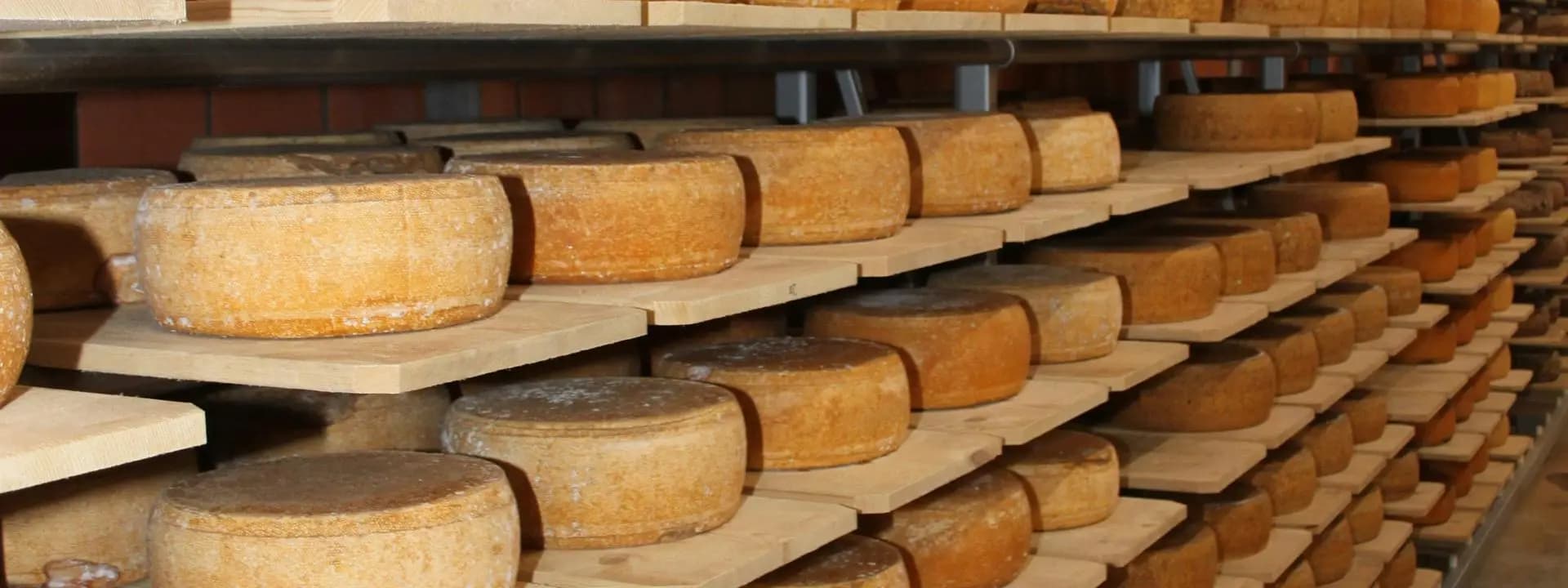
Read this also : Cheese is the By-Product Now :The Whey Revolution
The Disruptive Takeaway
The Heriot-Watt/Take Root Bio breakthrough isn't really about bioethanol — it's a signal that whey's status has permanently changed, from waste to contested resource, globally. India needs to stop treating that shift as a European problem and start treating it as a live domestic opportunity with its own, very different, math.
The honest position is a tiered one, not an either/or:
- Sweet whey and large organised dairies → push hard toward WPC/WPI and high-protein applications, where India is import-dependent and margins are enormous.
- Acid whey from paneer/chhena, especially in the unorganised sector → this is where bioethanol earns its place, not as a maize-killer, but as a decentralised, pollution-reducing, non-food-competing revenue stream that current policy — built around sugarcane, rice and maize — doesn't even recognise as a feedstock category yet.
- Policy → bring whey explicitly into the Ethanol Interest Subvention Scheme as a distinct, small-scale feedstock class, incentivised as much for effluent/BOD reduction as for litres of ethanol produced.
India doesn't need to choose between feeding people protein and fuelling cars with whey. It needs to admit that most of its whey was never going to become world-class protein anyway — and stop pretending the drain was ever the better option.
Source : Research article analysis by Kuldeep Sharma Chief Editor Suruchi Consultants
Research backup:
Insight taken from this article
Conversion factors and volume estimates in this piece are derived from published fermentation studies and industry data as cited; actual yields will vary by whey source, lactose concentration, fermentation strain and process design, and should be validated with pilot-scale trials before any investment decision.