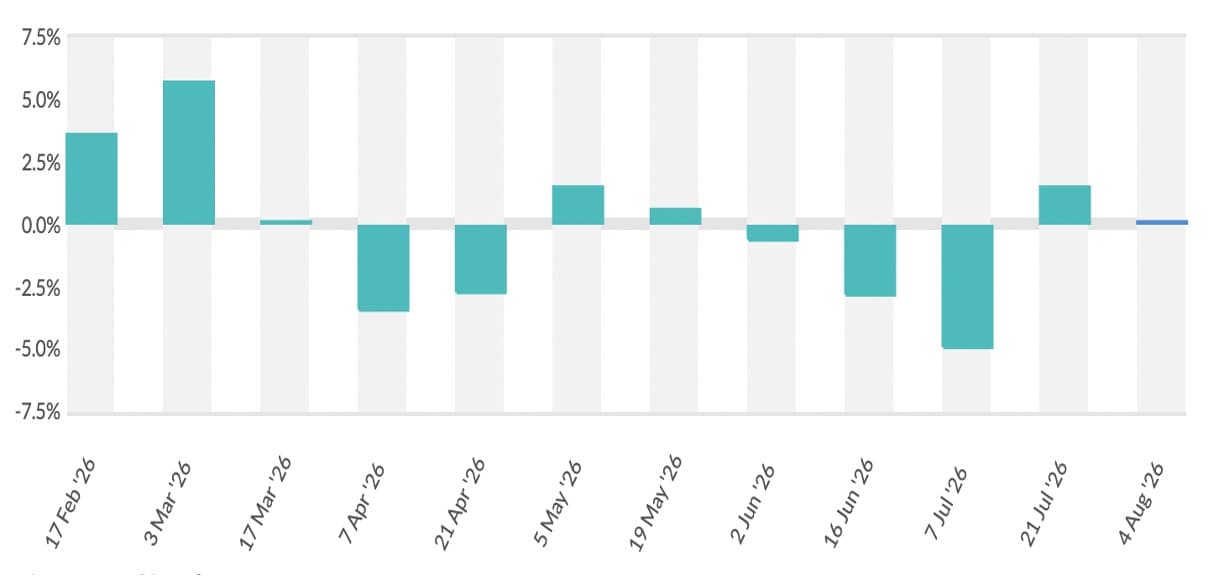
The global dairy market appears to be entering a phase of consolidation rather than a sharp directional movement. The latest Global Dairy Trade (GDT) Event 409, held on 4 August 2026, indicates that while milk powder prices have largely stabilised after the sharp correction witnessed during June and July, the milk fat segment continues to remain under pressure. The overall market is no longer displaying the broad-based weakness seen in the previous few auctions. Instead, buying has become increasingly selective, with importers actively supporting powder prices while remaining cautious on premium fat products. The latest auction suggests that the global dairy market is gradually finding a price floor, although sustained recovery will depend on stronger demand from major importing regions during the coming quarter.
The GDT Price Index recorded a modest positive movement, reflecting improving market confidence despite mixed performance across commodities. The auction once again attracted healthy international participation, demonstrating that buyers continue to view current price levels as commercially attractive. Procurement was largely driven by inventory replenishment rather than aggressive forward buying, indicating that most importers remain cautious amid global economic uncertainties, exchange rate volatility and comfortable product availability in several exporting countries.
Milk powders once again emerged as the most resilient segment of the auction. Whole Milk Powder (WMP), which accounts for the largest share of traded volumes on the GDT platform, increased marginally by 0.2% to USD 3,483/MT, suggesting that buyers continue to defend prices at current levels despite abundant global supplies. Skim Milk Powder (SMP) performed relatively better, increasing by 1.2% to USD 3,261/MT, indicating steady procurement by industrial users and food manufacturers. Although the gains were modest, they are significant because they reinforce the view that the steep decline witnessed during Events 406 and 407 has largely run its course. Buyers appear increasingly comfortable rebuilding inventories at prevailing prices, especially for medium-term requirements.
Among value-added dairy ingredients, Lactose continued its impressive performance, rising 4.1% to USD 1,780/MT, supported by sustained demand from infant nutrition manufacturers, pharmaceutical companies and specialised food applications. Mozzarella also strengthened by 1.0% to USD 3,992/MT, reflecting improving demand from foodservice and quick-service restaurant segments across several markets. These products continue to outperform many traditional dairy commodities, highlighting the growing importance of value-added dairy ingredients in global trade.
The strongest performer of the previous auction, Butter Milk Powder (BMP), however, witnessed a correction in Event 409. Prices declined 2.8% to USD 3,966/MT after the sharp rally recorded in Event 408. This correction appears to be largely technical in nature, as buyers paused following substantial purchases during the previous auction rather than indicating any structural weakness in demand.
The milk fat segment continued to remain under pressure. Butter declined further by 2.3% to USD 5,225/MT, extending the weakness observed over recent auctions. Buyers appear increasingly reluctant to purchase butter at premium prices as improved seasonal milk production in New Zealand and Europe enhances fat availability. Similarly, Anhydrous Milk Fat (AMF) eased by 0.8% to USD 6,367/MT. Although the decline in AMF was relatively limited compared with butter, it nevertheless indicates that premium milk fat markets are gradually adjusting to improved global supply conditions. The correction in fats is considerably milder than the sharp declines witnessed earlier this year, suggesting that the market may now be approaching a more balanced price range.
The cheese market remained mixed. Cheddar emerged as the standout performer within this category, rising 3.8% to USD 3,723/MT. The recovery reflects renewed buying interest from foodservice operators and retail processors who appear to have considered earlier price corrections sufficient to re-enter the market. Improved procurement by pizza chains, food manufacturers and institutional buyers also contributed to the stronger performance of cheddar during this auction.
Demand patterns across global markets continue to evolve. China remains an important buyer but is no longer the sole driver of international dairy trade. Import demand is now becoming increasingly diversified across Southeast Asia, the Middle East, North Africa and parts of Latin America, while several African countries continue to import competitively priced milk powders for recombination and nutrition programmes. This broader geographical spread of demand has significantly improved market resilience, reducing dependence on any single importing nation. Buyers across these regions are primarily focused on replenishing inventories rather than speculative purchases, resulting in a healthier and more sustainable demand environment.
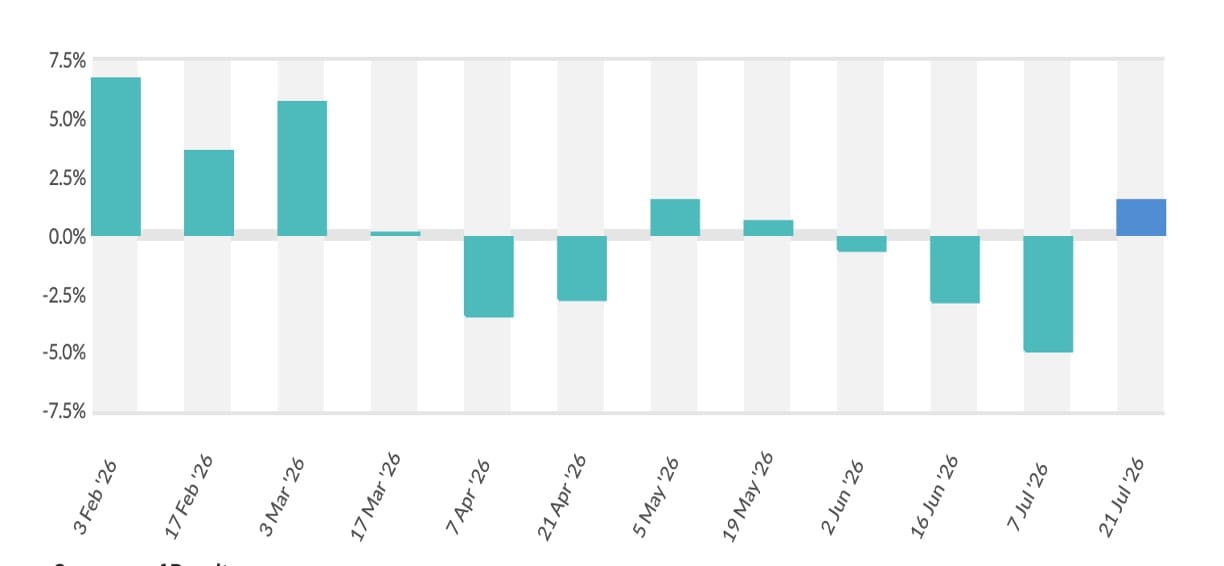
From a broader perspective, the GDT market has experienced multiple distinct phases during 2026. The year began with strong optimism during January and February as tight milk supplies and firm milk fat prices drove the GDT Index sharply higher. This was followed by a correction during April, June and early July, when improved milk production in major exporting regions, combined with cautious buying, exerted downward pressure on prices. Event 408 marked the first clear signs of recovery led by milk powders, while Event 409 confirms that the market is gradually stabilising. Instead of sharp price swings, global dairy trade now appears to be entering a period of consolidation where commodity prices are expected to fluctuate within relatively narrow bands.
Looking ahead over the next two to three months, the outlook appears cautiously positive. Whole Milk Powder is expected to trade broadly between USD 3,400–3,600/MT, while Skim Milk Powder is likely to remain in the USD 3,200–3,400/MT range with a slightly firmer bias. Butter prices may continue to face mild pressure until stronger seasonal demand emerges, whereas AMF is expected to remain relatively stable. Overall, the GDT Index is likely to remain stable to moderately positive, supported primarily by resilient demand for milk powders rather than milk fats.
For the Indian dairy industry, Event 409 offers encouraging signals. The stabilisation of international SMP prices reduces the risk of further erosion in export competitiveness and may gradually improve opportunities for Indian manufacturers if domestic inventories remain manageable. The continued correction in Butter and AMF suggests that global fat prices are unlikely to exert immediate upward pressure on domestic butter and ghee markets. However, India's own market dynamics remain significantly different. Buffalo milk availability is steadily declining across most milk-producing regions, while cow milk is also moving towards the seasonal lean phase. Consequently, domestic milk procurement prices are expected to remain firm irrespective of moderate weakness in international fat markets. Indian dairy companies should therefore continue to monitor global powder prices closely, as these are increasingly becoming the primary indicator of future international dairy market direction rather than milk fats.
Overall, Event 409 reinforces a clear message: the sharp correction phase appears to be behind the market. Milk powders are steadily regaining strength, value-added ingredients continue to attract healthy demand, and buyers are returning cautiously as price discovery improves. While the global dairy market has not yet entered a sustained bull phase, it is increasingly moving towards a more balanced and fundamentally supported pricing environment—one that should provide greater stability to both exporters and importers during the remainder of 2026.