Logo
IndianGlobalBlogsPublicationsPodcastsMarketAboutContact
Logo
IndianGlobalBlogsPublicationsPodcasts
7News
Feed Inflation Now Top Stress for India’s Dairy FarmersIndia’s Dairy Sector Rethinks Supply Trust & Nutrition StrategyU.S. Dietary Guidelines Overhaul Raises Dairy, MeatYear end review of Animal Husbandry and Dairy for the year 2025Fog & Frost Pose New Risks to Agriculture & Dairy in Punjab

Indian Dairy News

Feed Inflation Now Top Stress for India’s Dairy Farmers
Jan 09, 2026

Feed Inflation Now Top Stress for India’s Dairy Farmers

Dairy farmers across the country are facing intensifying economic stress as feed cost inflation emerges as the greatest pressure point for milk producers, with prices of all key inputs rising sharply,...Read More

India’s Dairy Sector Rethinks Supply Trust & Nutrition Strategy
Jan 09, 2026

India’s Dairy Sector Rethinks Supply Trust & Nutrition Strategy

India’s dairy industry — long anchored in high production volumes but thin value realisation — is undergoing strategic recalibration around supply reliability, consumer trust and long-term nutrition v...Read More

Year end review of Animal Husbandry and Dairy  for the year 2025
Jan 09, 2026

Year end review of Animal Husbandry and Dairy for the year 2025

Hon'ble Prime Minister inaugurates Regional Center of Excellence (CoE) for Indigenous Breeds established at Motihari with an investment of Rs 33.80 crore. Genotyping of 75000 animals from the first...Read More

DairyNews7x7
Advertisement

Latest Blogs

See More
From Forecast to Fact: 2025 Lessons, 2026 Dairy Outlook
Jan 01, 2026

From Forecast to Fact: 2025 Lessons, 2026 Dairy Outlook

As we step into 2026, it is worth pausing to reflect on how the Indian dairy sector navigated the challenges of 2025 and how closely reality tracked the forecasts I outlined in the first blog of last...Read More

India–NZ Dairy FTA: Safeguards or Silent Slippages?
Dec 26, 2025

India–NZ Dairy FTA: Safeguards or Silent Slippages?

The recently concluded India–New Zealand Free Trade Agreement (FTA) marks an important milestone in bilateral trade, while carefully ring-fencing India’s sensitive dairy sector. Under the agreement, c...Read More

Vision 2047: India’s Dairy Development Roadmap
Dec 21, 2025

Vision 2047: India’s Dairy Development Roadmap

As India moves steadily toward Vision 2047, the dairy sector stands at a strategic inflection point. From being a food security instrument in the decades following Independence, dairy has evolved into...Read More

Global Dairy Dynamics: Innovation, Sustainability & Inclusion
Dec 18, 2025

Global Dairy Dynamics: Innovation, Sustainability & Inclusion

The International Dairy Processing Conference (IDPC) 2026, organised by the Trade Promotion Council of India (TPCI) at Yashobhoomi Convention Centre, Dwarka, New Delhi on 7 January 2026, will serve as...Read More

Global Dairy News

U.S. Dietary Guidelines Overhaul Raises Dairy, Meat
Jan 09, 2026

U.S. Dietary Guidelines Overhaul Raises Dairy, Meat

The newly released 2025–2030 U.S. Dietary Guidelines, unveiled by Health Secretary Robert F. Kennedy Jr. and the Department of Agriculture, represent a major shift in federal nutrition policy, placing...Read More

Spoiled Dairy Becomes 3D Printing Plastic
Jan 07, 2026

Spoiled Dairy Becomes 3D Printing Plastic

Researchers patent a biomaterial from wasted milk proteins, creating biodegradable 3D printing filament and a potential new revenue stream for dairy. Excess milk that once flowed down farm drains duri...Read More

Milk production declines amid rising water costs
Jan 07, 2026

Milk production declines amid rising water costs

Dairy producers across Victoria are facing a tightening operating environment, with declining milk flows and escalating water and fodder costs, according to the Dairy Australia Situation and Outlook Y...Read More

DairyNews7x7
Advertisement
Dairy News 7x7

Your trusted source for all the latest dairy industry news, market insights, and trending topics.

FOLLOW US
CATEGORIES
  • Global News
  • Indian News
  • Blogs
  • Publications
  • Podcasts
SUBSCRIBE TO OUR NEWSLETTER

Stay informed with the latest updates and trending news in the dairy industry.

No spam, unsubscribe at any time

GET IN TOUCH
C-49, C Block, Sector 65,
Noida, UP 201307
+91 7827405029dairynews7x7@gmail.com

© 2026 Dairy News 7x7. All Rights Reserved.

Terms of ServicePrivacy Policy

Indo-US FTA : What’s in it for Indian dairy farmers ?

By DairyNews7x7•Published on July 19, 2020

India and USA are keen to sign an FTA deal soon. US is interested in having this deal signed before US presidential elections in November. Initial deal could conclude restoration of gsp status to Indian products in US. In turn USA has sought access to its farm and manufacturing products. The news may not be very good for Indian dairy farmers. In this report published by Grain , let us understand on whats in it for Indian dairy farmers.

India imposed sanitary and phytosanitary standards on dairy imports in 2003. These and similar market access have blocked the entry of US goods. In December 2018 ,India allowed dairy imports to enter from the US with strict mandatory certification. The certification required that the it should not be from cows fed with feed containing “blood meal, internal organs, or ruminant tissues” .

Use of blood meal and growth hormone in US

Such products would be unacceptable for the majority of Indians due to their cultural and religious sensitivities. The US has so far been reluctant to comply and describes these requirements as “scientifically unwarranted”. As per few reports , Indian government is considering offering restricted access to US dairy . This access may be granted with a 5% tariff and limited quotas under the FTA. This would be a big change from the current tariff of 30% to 60%.

Also read : US express concern over mandatory BIS feed regulation in India

Another big concern about US dairy products is the use of the genetically modified growth hormone. This hormone is known as the recombinant bovine somatotropin (rBST) . I t is used to increase cows’ milk production by 10-15%. Milk from rBST-treated cows is used to make ice cream, butter, cheese and yogurt. The US Food and Drug Administration has approved the use of this hormone back in 1993 . The use of hormones is banned in the EU, Canada, and many other countries but still it is used in the US. Despite that ,Canada is now forced to import rBST milk products from the US under the USMCA.

Fragmented milk production in India

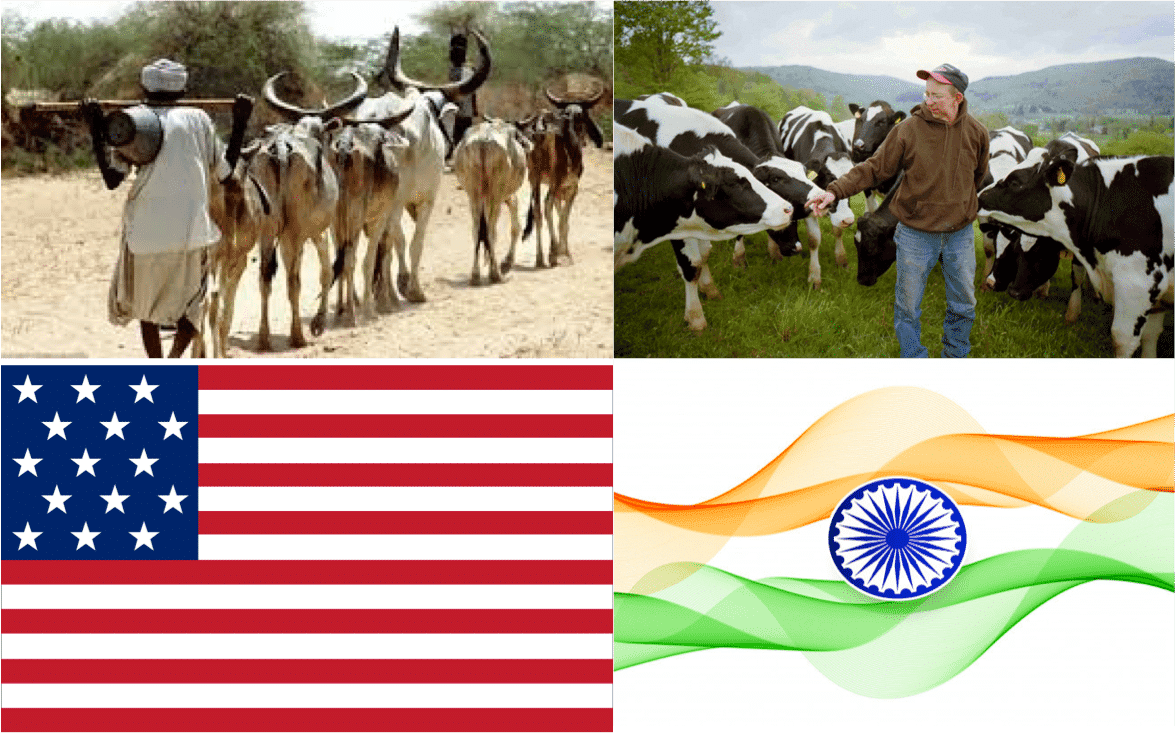
There are 150 million dairy farmers in India, producing more milk than any other country. The vast majority of these farmers are small landholders, with two or three cows or buffaloes. Dairy is the backbone of rural India. More than 70% of what consumers pay for milk goes to the producers.

Extensive dairy farming in USA

The dairy industry in the US consists of dairy farms with mega-sized operations. There has been a declining number of dairy farms and rising number of cows per farm. Around 35% of milk produced in the US comes from farms with more than 2,500 cows, and 45% comes from farms with less than 1,000 cows. Some of the mega dairy farms have as many as 30,000 cows. The increasing concentration of the sector requires government subsidies to offset prices which are lower than the cost of production.

In 2015, the US government doled out $22.2 billion in direct and indirect subsidies to its dairy sector. US dairy farmers operate at a loss, and have a higher cost of production that is higher than what they earn from the marketplace. The processors and manufacturers, especially Kraft Foods, Dean Foods and Land O’Lakes normally rely on the purchase of milk at prices below the costs of production. It offers them a significant competitive advantage.

USA strategy of expanding dairy exports under FTAs

The US dairy industry is expecting to boost revenues by $23 billion in the next decade due to the removal of tariff and non-tariff barriers under the US-China FTA.Similarly, the USMCA has created new market opportunities in Canada’s highly protected dairy sector.These include provisions on geographical indications that will help prevent future losses of US market access for cheeses with common names such as “blue” or “Swiss”.

US dairy exports are increasing by more than $314 million a year. It would grow under USMCA according to the International Trade Commission. The story with the US-Japan FTA is not very different. Japan agreed to eliminate its 40% cheese tariffs within 15 years and its whey duties in 5 to 20 years, depending on the type.In fact, Japanese tariffs on hard cheeses dropped from 29.8% to 26% on 1 January 2020 and to 24.2% on 1 April 2020.The priority given to dairy under these recent deals indicates that US corporations will want a substantial share of India’s market, too.

Analysis shared as per grain report on “Perils of the US-India free trade agreement for Indian farmers” dated May 26th 2020

Swipe to continue reading

Previous Article

Next Article