Latest Blogs
See More


Indian Dairy News


DairyNews7x7
Global Dairy News


DairyNews7x7
India’s journey from a milk deficit country to one of surplus has been momentous. Initiated in 1970, Operation Flood was arguably the world’s most ambitious dairy development programme that transformed India into one of the largest milk producers. India’s milk production rate in the past few decades has, in many ways, been symbolic of the upward trajectory of the country’s economy and influence. The per capita availability of milk in 2018-19 was 394 grams per day as against the world average of 302 grams.
Between 2016 and 2019, the annual milk production in the country registered a Compound Annual Growth Rate of 6.4 per cent. Today, with an annual production of 187.75 million tonnes (as per 2018-19 data), India accounts for about 22 per cent of the world’s milk production. However, India is yet to join the ranks of major milk exporting nations, as much of what we produce is directed towards meeting domestic demands. So, to unpack the issues facing our dairy sector, it is pertinent to dive deep and list out the factors that have been hampering the productivity levels of our cows.
Cross breeding has taken off in a big way because of the advancements in reproductive technologies like In Vitro Fertilization (IVF), embryo transfer process, and artificial insemination. Out of these processes, IVF and artificial insemination have proven to be the most popular and effective methods. Also Read – Looking at crime and punishment The NAIP (Nationwide Artificial Insemination Programme) Phase-I was launched by Prime , Narendra Modi in Mathura on September 11, 2019.
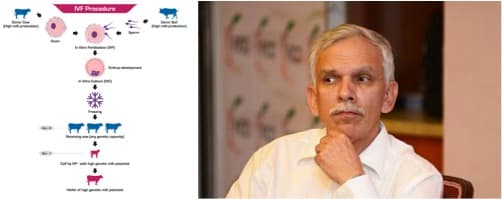
Consequently, 18 Million Metric Tonnes of additional milk will be produced, as average productivity will be enhanced from 1861 kg per animal per year to 3000 kg per animal per year. Until now, Artificial Insemination (AI) technology has been the most used method in India, but its success hinges upon accuracy in heat detection and timely insemination. And this is where In Vitro Fertilization (IVF) technology will prove to be more effective. IVF has become a helpful tool in crossbreeding as under this technology semen from different bulls can be used to fertilise each oocyte from a collection, that in turn enables greater genetic diversity from a single cow.
Source : The Hans India Feb,05,2021 (The writer is presently the Secretary at the Department of Animal Husbandry and Dairying under the Ministry of Fisheries, Animal Husbandry and Dairy. Views expressed are personal)