Logo
IndianGlobalBlogsPublicationsPodcastsMarketAboutContact
Logo
IndianGlobalBlogsPublicationsPodcasts
7News
World Pays More, Demands More: New Frontier of Dairy TradeIndia-EU Carbon Trade Talks: Why Dairy Is Watching CloselyDairy Demand to Spike for Makar Sankranti FestivalSouthern Dairy & Food Conclave Ends, Blending Technology with TraditionFarm Economy Seen Stabilizing in 2026; Costs & Policy Still Key Constraints

Indian Dairy News

India-EU Carbon Trade Talks: Why Dairy Is Watching Closely
Jan 11, 2026

India-EU Carbon Trade Talks: Why Dairy Is Watching Closely

India and the European Union (EU) are intensifying negotiations on a long-pending Free Trade Agreement (FTA), with the EU’s Carbon Border Adjustment Mechanism (CBAM) at the centre of climate and trade...Read More

Dairy Demand to Spike for Makar Sankranti Festival
Jan 11, 2026

Dairy Demand to Spike for Makar Sankranti Festival

As Makar Sankranti approaches, India’s dairy industry — especially in Bihar and neighbouring regions — is gearing up for a significant seasonal surge in demand for milk, curd and related dairy product...Read More

Southern Dairy & Food Conclave Ends, Blending Technology with Tradition
Jan 11, 2026

Southern Dairy & Food Conclave Ends, Blending Technology with Tradition

The Southern Dairy & Food Conclave 2026 (SDFC-2026) — organised by the Indian Dairy Association’s South Zone under the banner of the Southern Dairy Summit — concluded in Calicut (now Verghese Kurien N...Read More

DairyNews7x7
Advertisement

Latest Blogs

See More
From Forecast to Fact: 2025 Lessons, 2026 Dairy Outlook
Jan 01, 2026

From Forecast to Fact: 2025 Lessons, 2026 Dairy Outlook

As we step into 2026, it is worth pausing to reflect on how the Indian dairy sector navigated the challenges of 2025 and how closely reality tracked the forecasts I outlined in the first blog of last...Read More

India–NZ Dairy FTA: Safeguards or Silent Slippages?
Dec 26, 2025

India–NZ Dairy FTA: Safeguards or Silent Slippages?

The recently concluded India–New Zealand Free Trade Agreement (FTA) marks an important milestone in bilateral trade, while carefully ring-fencing India’s sensitive dairy sector. Under the agreement, c...Read More

Vision 2047: India’s Dairy Development Roadmap
Dec 21, 2025

Vision 2047: India’s Dairy Development Roadmap

As India moves steadily toward Vision 2047, the dairy sector stands at a strategic inflection point. From being a food security instrument in the decades following Independence, dairy has evolved into...Read More

Global Dairy Dynamics: Innovation, Sustainability & Inclusion
Dec 18, 2025

Global Dairy Dynamics: Innovation, Sustainability & Inclusion

The International Dairy Processing Conference (IDPC) 2026, organised by the Trade Promotion Council of India (TPCI) at Yashobhoomi Convention Centre, Dwarka, New Delhi on 7 January 2026, will serve as...Read More

Global Dairy News

World Pays More, Demands More: New Frontier of Dairy Trade
Jan 12, 2026

World Pays More, Demands More: New Frontier of Dairy Trade

Higher prices, tighter rules and an uncomfortable truth for the industry: without compliance, there is no market The start of 2026 has delivered a signal the global dairy industry cannot afford to ign...Read More

Midan’s Top 10 Meat & Dairy Trends to Watch in 2026
Jan 10, 2026

Midan’s Top 10 Meat & Dairy Trends to Watch in 2026

Midan Marketing has published its annual Top 10 meat and dairy industry trends for 2026, highlighting the forces likely to shape consumer behaviour, product development and value-chain strategies in t...Read More

U.S. Dietary Guidelines Overhaul Raises Dairy, Meat
Jan 09, 2026

U.S. Dietary Guidelines Overhaul Raises Dairy, Meat

The newly released 2025–2030 U.S. Dietary Guidelines, unveiled by Health Secretary Robert F. Kennedy Jr. and the Department of Agriculture, represent a major shift in federal nutrition policy, placing...Read More

DairyNews7x7
Advertisement
Dairy News 7x7

Your trusted source for all the latest dairy industry news, market insights, and trending topics.

FOLLOW US
CATEGORIES
  • Global News
  • Indian News
  • Blogs
  • Publications
  • Podcasts
SUBSCRIBE TO OUR NEWSLETTER

Stay informed with the latest updates and trending news in the dairy industry.

No spam, unsubscribe at any time

GET IN TOUCH
C-49, C Block, Sector 65,
Noida, UP 201307
+91 7827405029dairynews7x7@gmail.com

© 2026 Dairy News 7x7. All Rights Reserved.

Terms of ServicePrivacy Policy

GDT slip as volumes rise; butter rout narrows EU→US arbitrage

By DairyNews7x7•Published on September 17, 2025

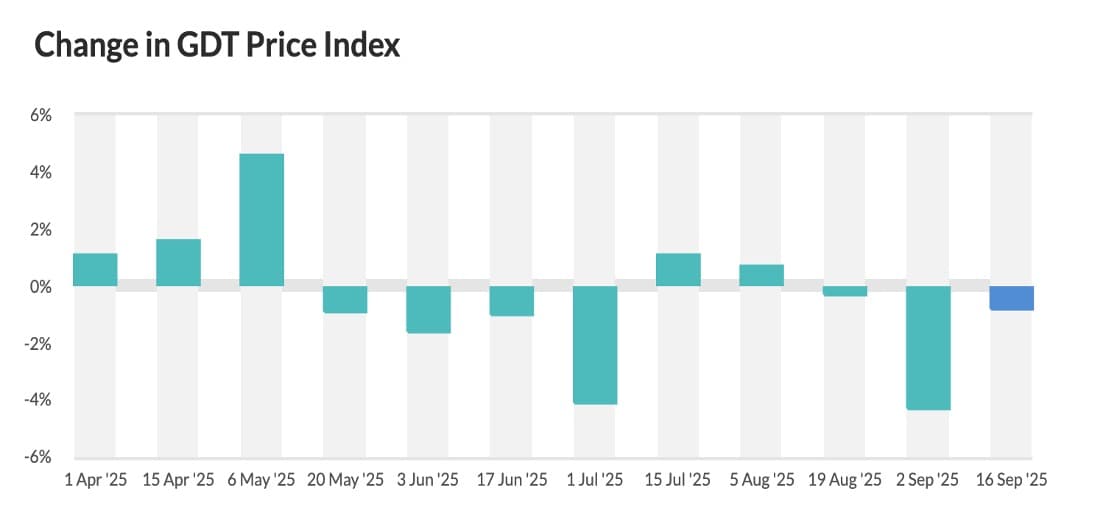
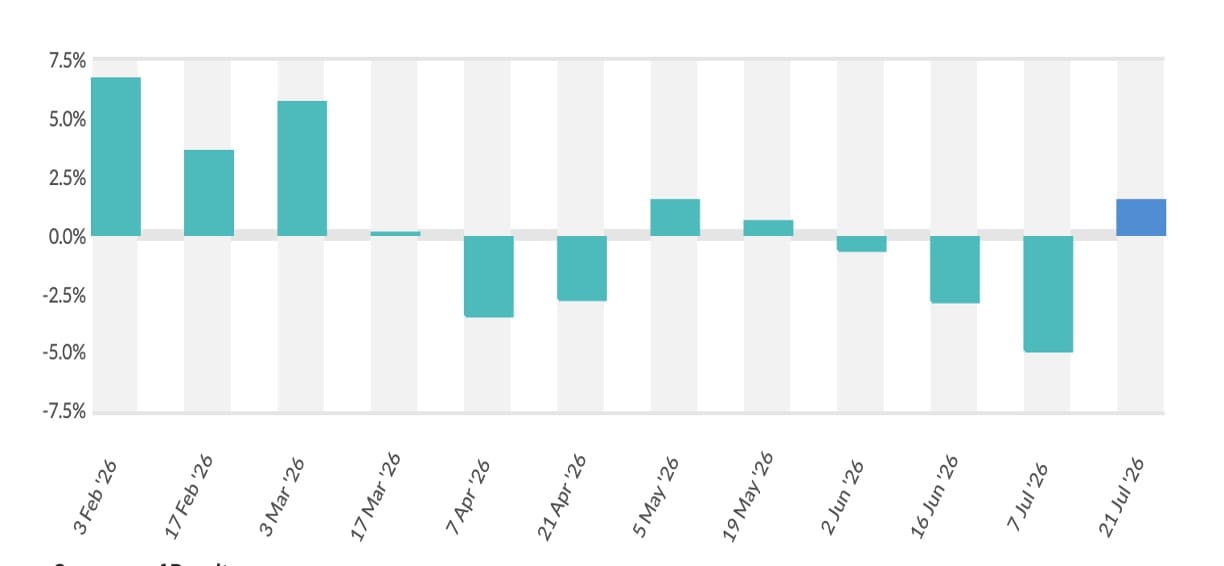
Global Dairy Trade’s Event 388 (16 Sept 2025) closed with the GDT Price Index down 0.8% versus the previous sale, a weighted average winning price near US$4,041/tonne, and 39,093 tonnes transacted — most of it milk-powder volume. Whole milk powder (WMP) and skim milk powder (SMP) were among the weaker categories, while cheddar showed mixed performance. The auction’s modest fall comes against a backdrop of higher offered volumes and softer demand from several regions, reinforcing a cautious tone across international dairy markets.

Detailed price snapshot (selected, Event 388 / contract summaries)

  • GDT weighted average price (all products): ~US$4,041/MT.

  • Whole Milk Powder (WMP): averaged around US$3,916/MT (down c.1–2% on some contracts).

  • Anhydrous Milk Fat (AMF): contract season prices in the range of US$6,700–6,800/MT on several calendar months.

  • Butter (CME/spot context): U.S. Grade AA butter spot has fallen below US$2.00/lb (roughly US$4,300–4,400/MT) in recent sessions — materially lower than EU butter references. (Contract-level price lines from the USDA/GDT recaps show small month-to-month softening across milkfat products).

Industry insight
Two forces are evident. First, supply and seller readiness pushed more powder onto the market this event, increasing total tonnes sold and pressuring prices for milk powders and some milkfat lines. Second, buyer demand remained selective — China and parts of Southeast Asia remain important marginal buyers, but their pull has been uneven, leaving northern hemisphere producers vulnerable to price correction. The result is a market where powder prices are consolidating lower and milkfat (butter/AMF) prices are under particular stress because of regional oversupplies and falling spot demand. This dynamic favors processors with flexible selling channels and storage capacity, while pressuring high-cost exporters.

Short-term forecast (1–3 months)

  • Expect mild downside pressure to persist for powders (WMP/SMP) unless a renewed round of buying from key importers (notably China and North Africa) returns. Higher available volumes and subdued conversions in parts of the supply chain mean price consolidation rather than sharp recovery is most likely.

  • Milkfat outlook is more uncertain: U.S. domestic butter spot weakness suggests near-term downside, but seasonally rising demand into Q4 (holiday baking) could provide intermittent support. Monitor buyer participation levels and major exporters’ shipping offers — if EU and Oceania volumes remain high, further pressure is likely. Overall, the market’s current bias is soft to neutral, with downside risks unless demand picks up.

Why the recent U.S. butter drop makes EU→US exports less viable 


Over the past weeks U.S. butter spot prices (CME / Grade AA) have slipped below US$2.00/lb (~US$4,300/MT), while EU butter reference prices have generally stayed much higher (Vesper’s EU index showed EU butter near €6,700/MT or roughly US$7,700–7,800/MT in late August). That creates a large price spread between EU ex-works and U.S. domestic spot levels. When you add freight, insurance, handling costs — and in many cases import duties or recently discussed tariff actions — the arbitrage for shipping butter from the EU to the U.S. largely disappears. In plain terms: EU suppliers cannot competitively sell into the U.S. unless EU prices fall sharply or the U.S. spot jumps; the recent U.S. butter fall therefore makes EU→US export economics unviable at current levels. This shift reduces one historical outlet for surplus EU butter and increases domestic pressure in Europe to find other markets or build inventories.

Concluding takeaways for traders & exporters

  1. Short hedges / caution: Traders should be cautious on long exposure to WMP/SMP and milkfat until buyer participation stabilises.

  2. Watch buyer hubs: China, North Africa and Southeast Asia remain crucial demand centres — any signs of restocking there could swing prices.

  3. Milkfat mismatch: Keep a close eye on butter spreads (EU vs U.S. vs Oceania) — a persistently wide gap will push EU sellers to pursue alternative buyers or offer deeper discounts, pressuring global milkfat values.

  4. Source : Dairynews7x7 Sep 17th 2025 Look at the results here 

Swipe to continue reading

Previous Article

Next Article