Latest Blogs
See More




Indian Dairy News

DairyNews7x7
Global Dairy News

DairyNews7x7

The use of donkey milk by humans for alimentary and cosmetic purposes has been popular since Egyptian antiquity. Hippocrates (460 – 370 BC), the father of medicine, was the first to write of the medicinal virtues of donkey milk. Pauline Bonaparte (1780–1825), Napoleon’s sister, is also reported to have used Donkey milk for her skin’s health care. In France in the nineteenth century, Dr. Parrot of Hospital des Enfants Assistès spread the practice of bringing motherless babies directly to the donkey’s nipple (Bullettin de l’Académie de médicine, 1882). The donkey’s milk was then sold until the twentieth century to feed orphaned infants and to cure delicate children, the sick and the elderly.
In India donkey farming for milk production is coming in vogue. A young IT professional has shown the world that one can make money by rearing donkeys. Aby Baby hailing from Ramamangalam in Ernakulam has 21 donkeys including one JAck (male and 20 Jennies ( females). Seven of these belongs to Poitou category and brought from Bikaner. This farm is selling milk from Rs 4500–Rs 7000 per liters and Urine at Rs 500 Liters. Donkey’s urine is used in Sidha medicine for cosmetic range of products.
As per senior scientist Dr Anuradha Bhardwaj, donkey milk doesn’t create any allergies in infants. This milk provides better immunity to the kids than other kinds of milk. Dr Anuradha has also conducted technologies to convert donkey milk into beauty products. The institute has sold the same technology to a leading company in Kerala.
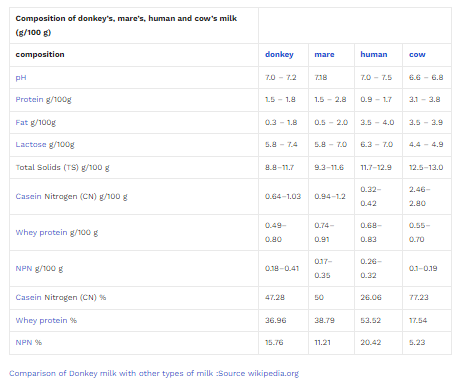
Vitamin C content in donkey milk is almost 4 times more of cow’s milk. Donkey milk contain more lactoferrin of cow milk and a considerable mounts of lysozyme, from 1.0 mg/mL to 4 mg/mL.For this reason, it has the potentiality, when properly formulated, to reduce problem skin with eczema, acne, psoriasis and herpes and properties in calming the irritation symptoms as reported by some authors. Today, donkey milk is still used in the manufacture of soaps and creams with donkey’s milk.