Logo
IndianGlobalBlogsPublicationsPodcastsMarketAboutContact
Logo
IndianGlobalBlogsPublicationsPodcasts
7News
World Pays More, Demands More: New Frontier of Dairy TradeIndia-EU Carbon Trade Talks: Why Dairy Is Watching CloselyDairy Demand to Spike for Makar Sankranti FestivalSouthern Dairy & Food Conclave Ends, Blending Technology with TraditionFarm Economy Seen Stabilizing in 2026; Costs & Policy Still Key Constraints

Indian Dairy News

India-EU Carbon Trade Talks: Why Dairy Is Watching Closely
Jan 11, 2026

India-EU Carbon Trade Talks: Why Dairy Is Watching Closely

India and the European Union (EU) are intensifying negotiations on a long-pending Free Trade Agreement (FTA), with the EU’s Carbon Border Adjustment Mechanism (CBAM) at the centre of climate and trade...Read More

Dairy Demand to Spike for Makar Sankranti Festival
Jan 11, 2026

Dairy Demand to Spike for Makar Sankranti Festival

As Makar Sankranti approaches, India’s dairy industry — especially in Bihar and neighbouring regions — is gearing up for a significant seasonal surge in demand for milk, curd and related dairy product...Read More

Southern Dairy & Food Conclave Ends, Blending Technology with Tradition
Jan 11, 2026

Southern Dairy & Food Conclave Ends, Blending Technology with Tradition

The Southern Dairy & Food Conclave 2026 (SDFC-2026) — organised by the Indian Dairy Association’s South Zone under the banner of the Southern Dairy Summit — concluded in Calicut (now Verghese Kurien N...Read More

DairyNews7x7
Advertisement

Latest Blogs

See More
From Forecast to Fact: 2025 Lessons, 2026 Dairy Outlook
Jan 01, 2026

From Forecast to Fact: 2025 Lessons, 2026 Dairy Outlook

As we step into 2026, it is worth pausing to reflect on how the Indian dairy sector navigated the challenges of 2025 and how closely reality tracked the forecasts I outlined in the first blog of last...Read More

India–NZ Dairy FTA: Safeguards or Silent Slippages?
Dec 26, 2025

India–NZ Dairy FTA: Safeguards or Silent Slippages?

The recently concluded India–New Zealand Free Trade Agreement (FTA) marks an important milestone in bilateral trade, while carefully ring-fencing India’s sensitive dairy sector. Under the agreement, c...Read More

Vision 2047: India’s Dairy Development Roadmap
Dec 21, 2025

Vision 2047: India’s Dairy Development Roadmap

As India moves steadily toward Vision 2047, the dairy sector stands at a strategic inflection point. From being a food security instrument in the decades following Independence, dairy has evolved into...Read More

Global Dairy Dynamics: Innovation, Sustainability & Inclusion
Dec 18, 2025

Global Dairy Dynamics: Innovation, Sustainability & Inclusion

The International Dairy Processing Conference (IDPC) 2026, organised by the Trade Promotion Council of India (TPCI) at Yashobhoomi Convention Centre, Dwarka, New Delhi on 7 January 2026, will serve as...Read More

Global Dairy News

World Pays More, Demands More: New Frontier of Dairy Trade
Jan 12, 2026

World Pays More, Demands More: New Frontier of Dairy Trade

Higher prices, tighter rules and an uncomfortable truth for the industry: without compliance, there is no market The start of 2026 has delivered a signal the global dairy industry cannot afford to ign...Read More

Midan’s Top 10 Meat & Dairy Trends to Watch in 2026
Jan 10, 2026

Midan’s Top 10 Meat & Dairy Trends to Watch in 2026

Midan Marketing has published its annual Top 10 meat and dairy industry trends for 2026, highlighting the forces likely to shape consumer behaviour, product development and value-chain strategies in t...Read More

U.S. Dietary Guidelines Overhaul Raises Dairy, Meat
Jan 09, 2026

U.S. Dietary Guidelines Overhaul Raises Dairy, Meat

The newly released 2025–2030 U.S. Dietary Guidelines, unveiled by Health Secretary Robert F. Kennedy Jr. and the Department of Agriculture, represent a major shift in federal nutrition policy, placing...Read More

DairyNews7x7
Advertisement
Dairy News 7x7

Your trusted source for all the latest dairy industry news, market insights, and trending topics.

FOLLOW US
CATEGORIES
  • Global News
  • Indian News
  • Blogs
  • Publications
  • Podcasts
SUBSCRIBE TO OUR NEWSLETTER

Stay informed with the latest updates and trending news in the dairy industry.

No spam, unsubscribe at any time

GET IN TOUCH
C-49, C Block, Sector 65,
Noida, UP 201307
+91 7827405029dairynews7x7@gmail.com

© 2026 Dairy News 7x7. All Rights Reserved.

Terms of ServicePrivacy Policy

Dairy Farming in Africa Dates Back At Least 6,000 Years

By DairyNews7x7•Published on January 30, 2021

Our history with milk presents a chicken-or-egg conundrum: Humans couldn’t digest the beverage before they evolved mutations that helped them do so, yet they had to already be consuming milk to change their DNA. “There’s always been the question of which came first,” says University of Pennsylvania geneticist Sarah Tishkoff. “The cultural practice or the mutation.”

Now, scientists have found some of the oldest evidence yet for dairy drinking: People in modern Kenya and Sudan were ingesting milk products beginning at least 6000 years ago. That’s before humans evolved the “milk gene,” suggesting we were drinking the liquid before we had the genetic tools to properly digest it.

Ability to digest milk as adults

All humans can digest milk in infancy. But the ability to do so as an adult developed fairly recently, likely in the past 6000 years. A handful of mutations allows adults to produce the enzyme lactase, which can break down the milk sugar lactose. Genes that enable what’s called lactase persistence are widespread in modern Africa, which has four known lactase persistence mutations. (European populations rely on just one.)

When these lactase mutations evolved, they spread rapidly—evidence that people who carried them had a big advantage. “It’s one of the strongest signals of natural selection ever observed,” says Tishkoff, who was not involved with the study.

Study of eight skeletals

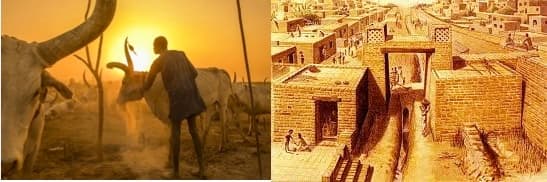
To peer into our milk-drinking past, researchers turned to Africa, where societies have herded domesticated cows, sheep, and goats for at least 8000 years. The scientists examined eight skeletons excavated in Sudan and Kenya, which were between 2000 and 6000 years old. They scraped hardened dental calculus from their teeth and looked for known milk-specific proteins trapped inside.

The findings revealed that these people were consuming some milk products kind of things around 6000 BC the team reports today in Nature Communications. That makes this the earliest known direct evidence for dairy consumption in Africa, and perhaps the world.

The research also shows dairying in Africa goes back just as far as it does in Europe—perhaps longer. That undercuts a myth, propagated by white supermacist, that lactase persistence and milk drinking are somehow associated with white Europeans.

What’s more, ancient Africans dont appear to have evolved any milk digestion genes according to a study of some of their skeletal DNA published in 2020. “It looks like the community was drinking milk before they had lactase persistence,” says Madeleine Bleasdale, a co-author of the new work and a specialist in ancient proteins at the Max Planck Institute for the Science of Human History.

Proteins from milk and fermented milks

The proteins could have come from milk, cheese, or fermented milk products like yogurt, which are common in Africa today. Fermentation is a strategy some cultures use to break down milk sugars before consuming them, which may make it easier for people without the adaptation to consume milk products without drinking raw milk.

The mutations may have eventually arisen because they helped people get more nutrients from their milk, giving them a leg up over their comrades, says Fiona Marshall, an archaeologist at Washington University in St. Louis who was not involved in the study. “Among those people, any individuals with lactase persistence would live longer and have more children.”

The selection pressure for lactase persistence might also have been environmental. Milking is a sustainable way to manage herds under tough conditions, allowing herders to get nutrition from their animals without killing them. During droughts, for example, lactase persistent herders could make better use of cattle and goats as four-legged water filters and storage containers. “If you have cows, you have a source of liquid and proteins and nutrition,” Tishkoff says. “As long as you can keep your cattle alive, of course.”

History of milk in India

One of the keys to sustaining the flourishing civilizations of the Indus Valley may have been the development of dairy production. Isotope analysis of lipid residues from ceramic vessels found at the site of Kotada Bhadli indicates that around 2500 B.C., dairy products were common there. This is the earliest such evidence known in India. Milk and cheese from domesticated cattle and water buffalo would have been a major component of the local diet, and any surplus could have been traded with other settlements.

Swipe to continue reading

Previous Article

Next Article