Logo
IndianGlobalBlogsPublicationsPodcastsMarketAboutContact
Logo
IndianGlobalBlogsPublicationsPodcasts
7News
World Pays More, Demands More: New Frontier of Dairy TradeIndia-EU Carbon Trade Talks: Why Dairy Is Watching CloselyDairy Demand to Spike for Makar Sankranti FestivalSouthern Dairy & Food Conclave Ends, Blending Technology with TraditionFarm Economy Seen Stabilizing in 2026; Costs & Policy Still Key Constraints

Indian Dairy News

India-EU Carbon Trade Talks: Why Dairy Is Watching Closely
Jan 11, 2026

India-EU Carbon Trade Talks: Why Dairy Is Watching Closely

India and the European Union (EU) are intensifying negotiations on a long-pending Free Trade Agreement (FTA), with the EU’s Carbon Border Adjustment Mechanism (CBAM) at the centre of climate and trade...Read More

Dairy Demand to Spike for Makar Sankranti Festival
Jan 11, 2026

Dairy Demand to Spike for Makar Sankranti Festival

As Makar Sankranti approaches, India’s dairy industry — especially in Bihar and neighbouring regions — is gearing up for a significant seasonal surge in demand for milk, curd and related dairy product...Read More

Southern Dairy & Food Conclave Ends, Blending Technology with Tradition
Jan 11, 2026

Southern Dairy & Food Conclave Ends, Blending Technology with Tradition

The Southern Dairy & Food Conclave 2026 (SDFC-2026) — organised by the Indian Dairy Association’s South Zone under the banner of the Southern Dairy Summit — concluded in Calicut (now Verghese Kurien N...Read More

DairyNews7x7
Advertisement

Latest Blogs

See More
From Forecast to Fact: 2025 Lessons, 2026 Dairy Outlook
Jan 01, 2026

From Forecast to Fact: 2025 Lessons, 2026 Dairy Outlook

As we step into 2026, it is worth pausing to reflect on how the Indian dairy sector navigated the challenges of 2025 and how closely reality tracked the forecasts I outlined in the first blog of last...Read More

India–NZ Dairy FTA: Safeguards or Silent Slippages?
Dec 26, 2025

India–NZ Dairy FTA: Safeguards or Silent Slippages?

The recently concluded India–New Zealand Free Trade Agreement (FTA) marks an important milestone in bilateral trade, while carefully ring-fencing India’s sensitive dairy sector. Under the agreement, c...Read More

Vision 2047: India’s Dairy Development Roadmap
Dec 21, 2025

Vision 2047: India’s Dairy Development Roadmap

As India moves steadily toward Vision 2047, the dairy sector stands at a strategic inflection point. From being a food security instrument in the decades following Independence, dairy has evolved into...Read More

Global Dairy Dynamics: Innovation, Sustainability & Inclusion
Dec 18, 2025

Global Dairy Dynamics: Innovation, Sustainability & Inclusion

The International Dairy Processing Conference (IDPC) 2026, organised by the Trade Promotion Council of India (TPCI) at Yashobhoomi Convention Centre, Dwarka, New Delhi on 7 January 2026, will serve as...Read More

Global Dairy News

Midan’s Top 10 Meat & Dairy Trends to Watch in 2026
Jan 10, 2026

Midan’s Top 10 Meat & Dairy Trends to Watch in 2026

Midan Marketing has published its annual Top 10 meat and dairy industry trends for 2026, highlighting the forces likely to shape consumer behaviour, product development and value-chain strategies in t...Read More

U.S. Dietary Guidelines Overhaul Raises Dairy, Meat
Jan 09, 2026

U.S. Dietary Guidelines Overhaul Raises Dairy, Meat

The newly released 2025–2030 U.S. Dietary Guidelines, unveiled by Health Secretary Robert F. Kennedy Jr. and the Department of Agriculture, represent a major shift in federal nutrition policy, placing...Read More

Spoiled Dairy Becomes 3D Printing Plastic
Jan 07, 2026

Spoiled Dairy Becomes 3D Printing Plastic

Researchers patent a biomaterial from wasted milk proteins, creating biodegradable 3D printing filament and a potential new revenue stream for dairy. Excess milk that once flowed down farm drains duri...Read More

DairyNews7x7
Advertisement
Dairy News 7x7

Your trusted source for all the latest dairy industry news, market insights, and trending topics.

FOLLOW US
CATEGORIES
  • Global News
  • Indian News
  • Blogs
  • Publications
  • Podcasts
SUBSCRIBE TO OUR NEWSLETTER

Stay informed with the latest updates and trending news in the dairy industry.

No spam, unsubscribe at any time

GET IN TOUCH
C-49, C Block, Sector 65,
Noida, UP 201307
+91 7827405029dairynews7x7@gmail.com

© 2026 Dairy News 7x7. All Rights Reserved.

Terms of ServicePrivacy Policy

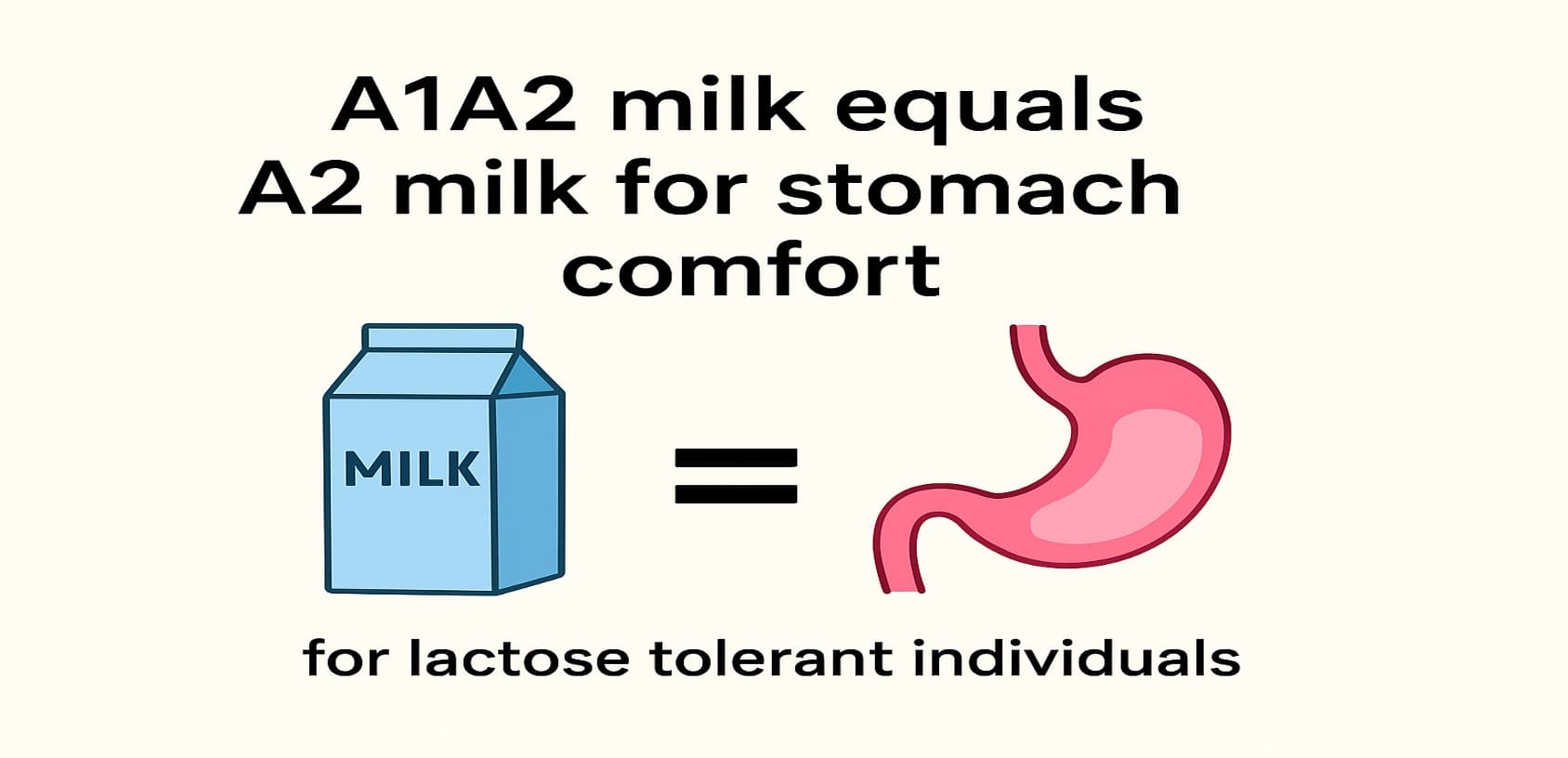
Hydrolyzed A1A2 Milk Matches A2 in Stomach Comfort

By DairyNews7x7•Published on October 01, 2025

A recent Finnish study investigated the effects of A2 milk, marketed as a gut-friendly alternative, and protein-hydrolyzed lactose-free milk on gastrointestinal symptoms and inflammation levels. The study found that protein-hydrolyzed lactose-free milk was as tolerated as A2 milk by lactose-tolerant individuals and better tolerated by lactose-intolerant individuals.

The best-known cause of milk-induced gastrointestinal symptoms is lactose intolerance, which is an inability to digest lactose, a sugar found in dairy products. However, many people experience gut symptoms when ingesting milk and avoid dairy products even though they are lactose-tolerant according to their genotype.

Cow's milk products sold in Finland typically contain both A1 and A2 beta-casein proteins. However, some cows naturally produce only A2 beta-casein, and their milk has long been available globally as a separate product. This A2 milk is marketed as a gut-friendly alternative to regular A1A2 milk, even though previous research on the symptoms caused by A2 milk has, for example, neglected the role of lactose as a cause of symptoms. In addition to the lactose content and the type of beta-casein in the milk, the partial breakdown of milk proteins during processing called hydrolysis can affect how the gut reacts to milk.

A recent clinical study conducted at the Food Sciences Unit of the University of Turku in Finland investigated the effects of A2 milk and protein-hydrolyzed lactose-free A1A2 milk on gastrointestinal symptoms and inflammation in people who experience gut symptoms from milk. In the study, lactose-tolerant and lactose-intolerant participants were divided into two groups, and the symptoms of each group were monitored separately during the trial periods of the different milk alternatives.

Least stomach symptoms were observed with lactose-free protein hydrolysed A1A2 milk

The results of the study show that breaking down milk proteins is a promising method for people who are sensitive to milk, as A2 milk and protein-hydrolyzed A1A2 milk caused equally less stomach symptoms for lactose-tolerant individuals. In contrast, lactose-intolerant participants had a clear increase in gut symptoms when the lactose content in the milk increased.

"Of the milks investigated in our study, the lactose-free, protein-hydrolyzed A1A2 milk was the best milk choice for lactose-intolerant people, and it was at least as stomach-friendly as A2 milk for those who can tolerate lactose," says Principal Investigator Kaisa Linderborg, Professor of Molecular Food Sciences at the University of Turku.

However, some participants got gastrointestinal symptoms from all types of milk, and also during the research period when they were entirely without dairy products. The researchers found no differences in inflammatory markers, such as high-sensitivity CRP and fecal calprotectin, between the dairy-free diets and the different milks. In addition, no significant changes were observed in the levels of individual cytokines.

This was the third study conducted in our unit on milk-related gastrointestinal symptoms. We found the same challenge as with the previous studies, namely that milk is not the only cause of gut symptoms, but that there are usually also other factors behind them. This time, however, the genotyping of the participants by lactase enzyme and the partial protein hydrolysis added novelty to the study."

Kaisa Linderborg, Professor, Molecular Food Sciences, University of Turku

The study had 36 participants. Participants were divided into two groups based on their lactase enzyme genotype, which allowed the researchers to study the groups according to their lactose tolerance. The study was conducted as a randomized, three-leg, crossover trial, with participants completing all the study periods in a random order. The participants started with a wash-out of milk-free week for baseline measurements, and continued with study periods of consuming regular A2 milk, A2 milk with lactase enzyme, and lactose-free protein hydrolyzed A1A2 milk. In the study, the researchers examined gastrointestinal symptoms, fecal calprotectin, and plasma inflammation markers. During the study periods, the participants avoided other dairy products and gave blood and stool samples after each period.

"We would have liked to include, for example, a lactose-containing A1A2 milk and a dairy-free option as controls, but it was not possible this time. In such long nutrition studies, participants must be highly motivated to complete the study," says Professor Linderborg.

The lack of an answer to the symptoms of lactose-tolerant participants indicates a great diversity in the cause and experience of gut symptoms. The results highlight the importance of individual lactose tolerance and suggest that gut symptoms may be caused by several factors, even if they are perceived to be caused by a single food group. The study provides new insights into the source of diet-induced gastrointestinal symptoms and may help in the development of dairy products for sensitive consumers.

Source : Dairynews7x7 Oct 1st 2025 University of Turku

Swipe to continue reading

Previous Article

Next Article