Latest Blogs
See More


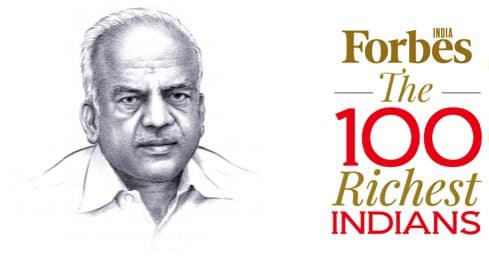
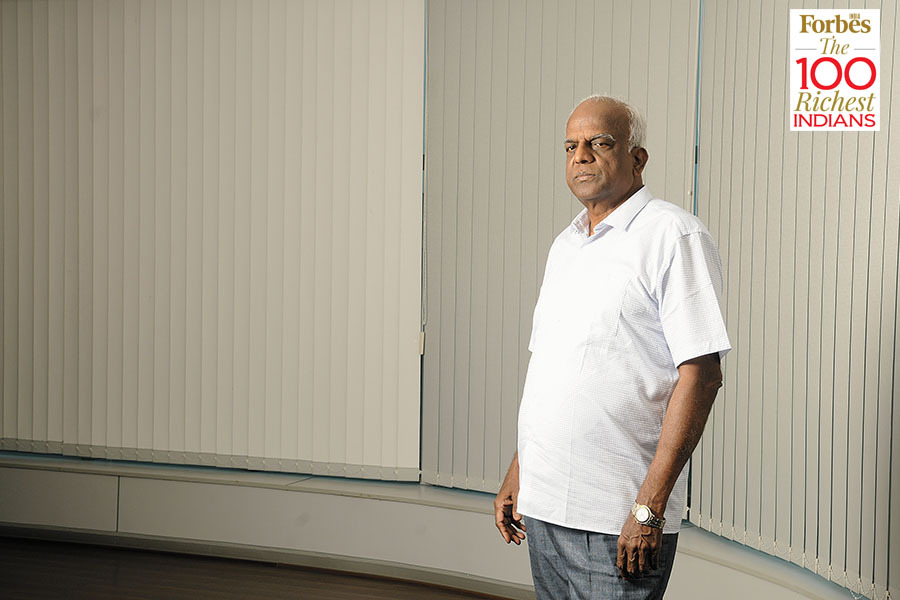 R G Chandramogan,MD of Hatsun[/caption]
G Chandramogan loves numbers. In fact, back in school, mathematics was among his favourite subjects.“Everybody around me knows that I am good with numbers,” says the chairman and managing director of Chennai-based Hatsun Agro Products, India’s largest private sector dairy company. “All my life I have been fascinated by numbers. There was a time when I used to remember phone numbers before mobile phones came by.”His close aides reckon the 71-year-old is a prodigy, almost like a human computer when it comes to calculations, down to the last decimal. “Many of us need calculators to do maths,” says H Ramachandran, the chief financial officer of Hatsun Agro Products. “With him, however, all that calculation is in his head.”Perhaps it’s ironic then that it was failing at mathematics that helped him make a tryst with destiny many years ago.
Five decades ago, Chandramogan failed his mathematics exam while appearing for his pre-university course (PUC), a precursor to college education. He attempted it once again a year later, but walked out of the hall a few minutes into the examination.“My mind was in turmoil while appearing for those papers,” Chandramogan says. Much of the distress was due to his family’s dwindling fortunes, after his father’s small-time provision store closed. “That’s when I knew I had to chart my path,” he says.
A year or so later, with seed money of Rs 13,000 from his father, he set up a factory to make ice cream candies. Today, Chandramogan is worth $1.3 billion, making him India’s 100th richest person, and earning him a place on the Forbes India Rich List. His company Hatsun Agro Products has made giant strides in the dairy industry, and is today the country’s largest private dairy company by sales. Hatsun procures close to 33 lakh litres of milk everyday from over 4 lakh farmers and sells milk, curd, ice creams and ghee through its brands Arun Ice Creams, Arokya Milk, Hatsun Curd, Hatsun Paneer and Ibaco.Hatsun, a play on ‘Hot Sun’, exports its products to over 38 countries around the world, particularly the US, the Middle East and South Asian markets. Within India, much of the company’s focus remains on the South Indian market, where it controls nearly 17 percent of all the milk sold, according to Chandramogan, and over 40 percent of the ice cream market.“We are dominant in southern India,” Chandramogan says. “Today, the turnover we make in 30 minutes is equal to what we used to make in the first 10 years of our business.”
“In my village, most of the successful people were businessmen,” he says. “We were not exposed to successful people with a career in the corporate world in those days.”While the family owned a few ancestral properties in the rain-deficit village, there wasn’t much income to sustain the household. So Chandramogan’s father moved to Madras, now Chennai, and set up a provision store in 1956 near the Chennai Central Station. “But he was of a philanthropic mindset and his interest was in social work,” Chandramogan says. “By 1968, we had to wind up the business and he went back to my hometown.”
[caption id="attachment_5368" align="alignnone" width="900"]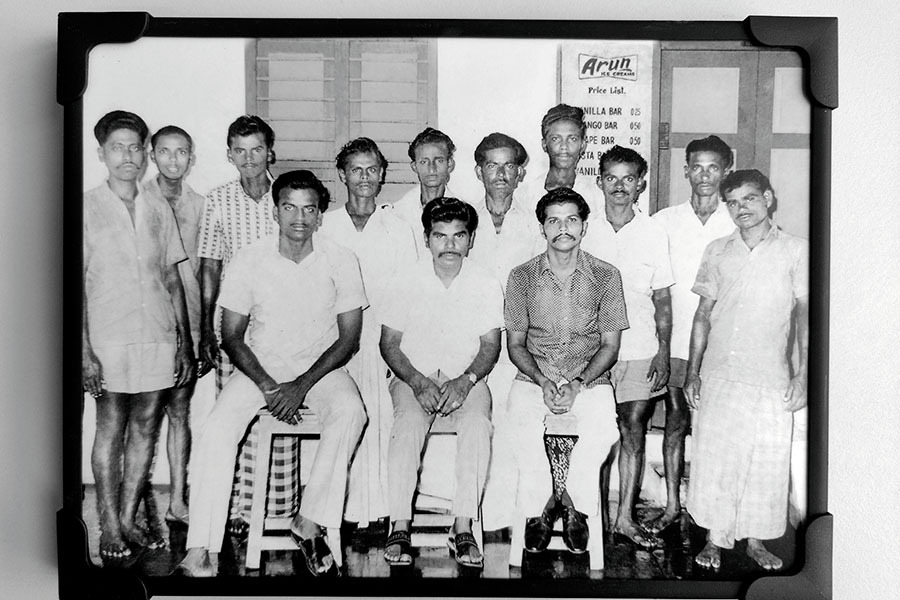 Chairman taken at his first factory set up. Standing behind him are pushcart vendors.[/caption]
RC Chandramogan (seated, first from left) at the first factory of Arun Ice Creams, with pushcart vendors standing behind Courtesy: Hatsun
”His father then found him a job at a timber depot as an apprentice in Viluppuram, about 160 km from Chennai, on a salary of Rs 65. “I worked there for a year, and then came back to Chennai,” Chandramogan says. That’s also when he decided he would focus on becoming an entrepreneur. “To accommodate the son, who wasn’t up to his expectations, my father sold our ancestral land for Rs 13,000,” Chandramogan says. That became his seed capital, though his father believed the money was “marooned”.
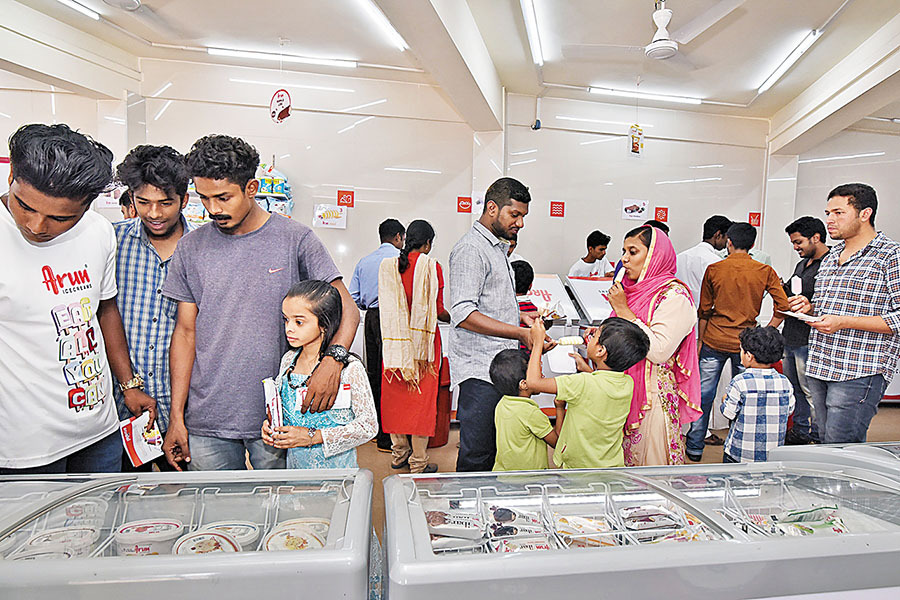
A Hatsun ice cream outlet in Kerala. The company is a dominant player in South India Courtesy: Hatsun
Back then, Chandramogan reckons there were some 40,000 companies selling ice candies across India. The candies were sold on pushcarts by vendors, and there were some 3,000 such factories in Tamil Nadu alone. “I wanted to prosper. I found there was no way I was going to [always] sell ice candy to vendors,” he says. “I decided to move into the league of the biggies.”Back then, the ice cream industry in Tamil Nadu was dominated by Dasaprakash Ice Cream, followed by Mumbai-based Joy Ice Cream and Kwality Ice Cream, owned by Hindustan Unilever.
“The first three businesses were capital-intensive,” Chandramogan says. “We needed deep freezers, supply credit and customers also looked for a brand. We didn’t have the muscle power or money. Even if we put in freezers, no customer was willing to buy my brand.”Together, these businesses accounted for almost 90 percent of the ice cream industry in Chennai. The remaining 10 percent were the colleges and ships. “The college messes were run by secretaries, who were 18 to 20-year-olds. I was around that age,” Chandramogan says. It also helped that they were looking for reliable partners, with dependable supplies and good quality.That opened up a huge market, and Arun began ploughing back the money into ramping up technology and machinery.
“The ice cream market was confined to big cities because ice cream was still consumed [mainly] by the urban population. We thought, why not try the outstation market.”Over the next few years, the company ventured into towns such as Erode, Tuticorin, Tirunelveli, Salem and Kumbakonam. The company also developed a franchise model, with owners being asked to invest in the machinery, including deep freezers to store the ice creams that would be brought from Chennai. The franchisees were also given an exclusive territory. “All this while the three big players didn’t know the rural market,” Chandramogan says.
[caption id="attachment_5370" align="alignnone" width="900"]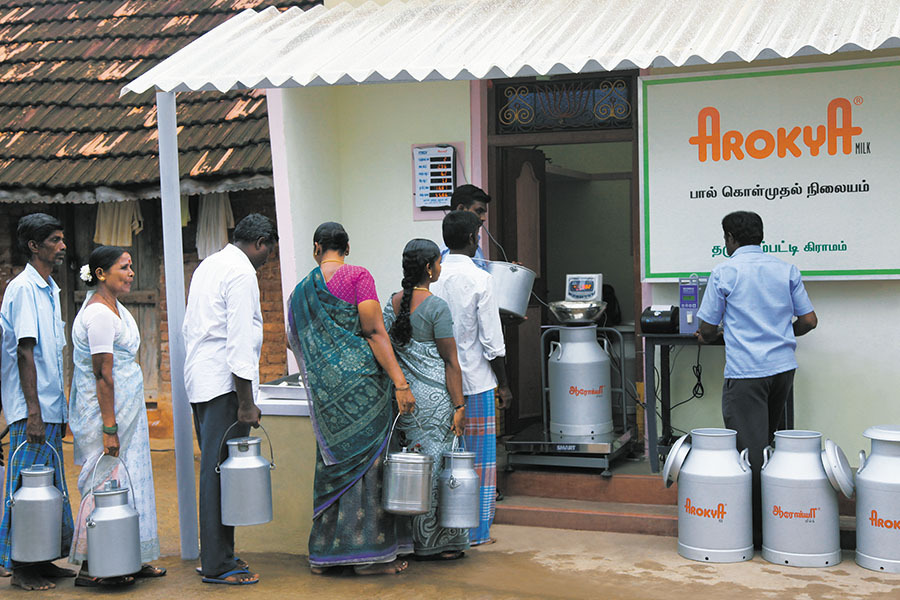 Dharmapuri Tamil Nadu; Fresh milk brought in by farmers are tested for quality, Fat and SNF and is weighed in front of them. The board (in the left) instantly displays the parameters and the procurement rate, total milk quantity etc. An SMS is also instantly generated and sent to farmer's registered mobile numbers.[/caption]
Dairy farmers line up at a Hatsun milk procurement centre in Dharmapuri, Tamil Nadu. The fresh milk is tested for quality and is weighed. A digital board (on the left) displays various parameters and procurement rates. An SMS is sent to the farmer’s mobile phone with the details Courtesy: Hatsun
”While most of the rivals were trying to sell a variant of toned milk with 3 percent fat, Chandramogan decided to sell milk with 4.5 percent fat. “If we went in without a product differentiator, we would have collapsed. Because the costs weren’t going to match. I was not going to compromise on the quality and reduce the price.” The company launched its milk at the existing rate of `7.50 and, over time, raised it to match the real cost. The idea behind selling milk with 4.5 percent fat was also because Chandramogan felt it was better for children’s growth.Today, a bulk of the company’s sales comes from milk with 4.5 percent and 6 percent fat, while the 3 percent category remains minuscule.Besides, Hatsun began to procure milk directly from farmers.
The company also claims to be the world’s first dairy company to develop and use thermal battery-based technology in its Bulk Milk Coolers for chilling milk immediately after procurement.“We don’t invest in unwanted property, unwanted share investments etc. All our investment is only into this business. We don’t live a very extravagant life.” It also helped that the company enforced financial discipline, ensuring that all delivery was made against payments. “So, financially we were able to rotate the working capital much better,” Chandramogan says.The ice cream business contributes about 11 percent of overall revenue. “The consumer base is bigger in ice creams, but the frequency varies,” Chandramogan says.
“There is tremendous opportunity in the dairy sector for Hatsun to grow,” says Nitin Puri, senior president and global head for food and agriculture research at Yes Bank. “Almost two-thirds of the industry is in the unorganised category. With the Covid-19 crisis, there is a massive disruption, particularly in customer preferences for buying milk. Hatsun has managed to crack the sector well, and has managed to build a scalable business.”A bulk of that, Puri reckons, is also due to Hatsun’s early foray into direct procurement from farmers. “Much before many others forayed into direct procurement, Hatsun engaged with farmers directly.
That helped them secure their back-end, and they also kept innovating, such as with the thermal battery-based milk coolers for areas with poor electricity.”All of which means Chandramogan isn’t ready to hang up his boots anytime soon. “Since 2015, we began to focus on ice creams again,” the billionaire says. “We are now seeing faster growth in the business and we want to grow it further. Among the 40,000 similar ice candy manufacturers who ran a cottage industry in 1970 like us, we are the only ones who made it to the big league in the entire country.”Has becoming a billionaire changed anything? “All this is notional wealth,” Chandramogan says. “I don’t consider myself to be a billionaire. In fact, the only asset I have is a house.”
BY MANU BALACHANDRAN UPDATED: Nov 12, 2020 01:09:01 PM IST